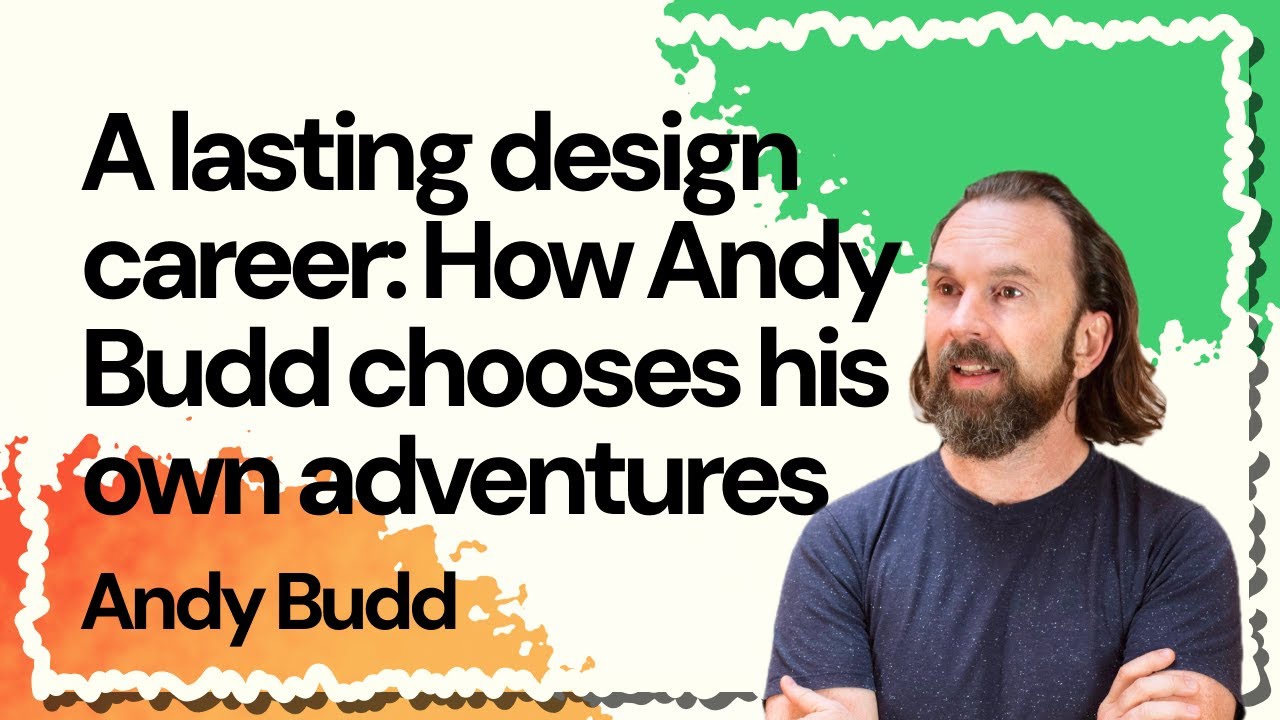
As soon as tools exist that don't require Figma's learning curve, a very large number of designers will find themselves out of work
*
Summary
*
Today I'm sharing a wide-open, deeply honest conversation with Andy Budd — designer, founder, conference creator, coach, investor, and one of the most quietly influential forces behind the UK design and product community. If you've worked in UX anytime in the last two decades, you've almost certainly felt Andy's impact: Clearleft, UX London, dConstruct, Leading Design, CSS Mastery, the Brighton Digital Festival… the list is long for a reason.
In this episode, we dig into the questions so many designers are quietly wrestling with; Have we already passed "peak designer"? And what does a meaningful, sustainable design career look like on the other side?
We explore why 2020–21 marked the high-water point for UX hiring, how AI and automation are reshaping the work, and why "Figma operator culture" was always a dead end. Andy maps the design chaos from identity crisis many designers are feeling, the discomfort of reinvention, and why embracing uncertainty is now a core skill. We also journey through his experiences with the early web, Clearleft, building communities, leadership — and the ongoing search for new personal S-curves.
If you're feeling energised, anxious, confused, optimistic (or all of the above) about where design is heading, this one will resonate deeply.
*
Guest
*
Andy Budd
LinkedIn
Website
Book
Website
*
Host
Danny Hearn
Website
Podcast
*
(00:00) Andy Budd
I would say that a very, very large number of designers will…
suddenly find them as an out of work. And we’ve already seen this. I think we reached peak designer in 2020. I think 2020, 2021, there was a massive hiring boom and it was really hard to find designers. I think now, you know, lot of people I talk to sadly, like are struggling. A lot of people who would have got a job immediately, you know, they would have been fired on a Friday and had a job on a Monday and now taking six months or a year to find their next job.
(00:07) Danny
Yeah.
Andy, I’m really excited. Like, I am actually really excited to talk to you. You’ve actually been quite a big part of my journey at various points, and we’ve crossed paths at different points. And I was trying to think about how to introduce you. And I know that everybody hates these bios and all this. And you actually said that on one of your talks, you said, I hate the old bio. But like, I did a quick flash, I was like,
(00:58) Andy Budd
Mm-hmm.
(01:08) Danny
I think I could, the roles that I’ve understood that you’ve encompassed is designer, author, founder, speaker, mentor, investor, pilot, diver and shark wrangler. Did I miss anything?
(01:12) Andy Budd
Mm-hmm.
Mm-hmm. Mm-hmm.
Mm-hmm.
Yeah,
that’s some of them. I mean, I’m sure there’s lots more, but that’s probably enough to be going with,
(01:25) Danny
Yeah.
Yeah, yeah. And I wonder perhaps who can ground this for people that maybe haven’t come across your work? Like, how would somebody understand you? if they haven’t met you before, how would you explain a little bit of your origin story?
(01:42) Andy Budd
Great. mean, again, I can talk at length for this. I’ll try not to go too long, but I guess basically it comes from, I guess it comes from a child of just being interested in the stuff, interested in the world. know, I was brought up as a kid who would read books about science and nature and engineering. And I was that typical kind of geeky kid that wanted to…
(01:45) Danny
Yeah.
(02:01) Andy Budd
play with Lego and Meccano and kind of build things and understand how the world works. I was really lucky that I had parents that would take me around to museums and art galleries and ask me sort of difficult questions. And so I guess when the internet sort of emerged, that was a great place to do things. First of all, to find answers, back in the early days, you could just go and…
and literally surf the internet from link to link to link. This was before the days of Google when you had a functional search engine and you just get lost in this kind of like beautiful array of knowledge. And so I started being a web person as a user and kind of fell in love with it. And I also quite like the ethos, I guess, when I was getting into the web, I guess I’ve always been a little bit more kind of sort of left-leaning. I’ve been a little bit more kind of believing in,
I know human potential and the ability for communication to help solve a whole bunch of problems around the world. think later on, it’s also been clear that that’s caused maybe more problems than it’s solved. But I think in the early days, I was a real believer in the ability of the web to kind of know, connect people and make life more interesting and better. And so my origin story in terms of getting into the web was twofold. So I was sat in a…
⁓ internet cafe in Sulawesi in Indonesia ⁓ while I was traveling around Asia. And I was sat there doing my Hotmail and there was a guy next to me who wasn’t doing Hotmail. And this was really weird because everyone else is on Hotmail emailing. And this person had this screen and it was all black and green and all these like weird angle brackets and curly braces. And I was like, what the hell is that person doing? And so when he got up to step away and finish his session, I kind of summoned up the courage and was like, excuse me.
what were you doing there? You weren’t doing hotmail. And he’s like, oh, I’m making a website. And I know this sounds really stupid, but prior to that point, I didn’t think a website was something you could make. I didn’t think it was something I could make. I assumed it happened in a computer science lab, in a big company, in a basement somewhere with big servers, and it was a team sport. And I suddenly, yeah, absolutely. was kind of, felt like it was something that was something that other people did.
(04:01) Danny
Yeah, Dark arts.
(04:09) Andy Budd
And this person kind of just really exposed me to this idea that, look, you know, I’m traveling around Indonesia rather than emailing all of my friends. I’ve built this website. This was before the term blog had appeared and, you know, uploading my photos, I get them scanned, I put them online and I can tell people. So I thought, well, that sounds like a really good fun thing to do. I want to learn how to do this. And then the second thing that got me into the web was I was sat in a ⁓ hostel in Singapore.
(04:09) Danny
Yeah.
(04:35) Andy Budd
chatting to this guy and was like, you know, at the time I was a diving instructor, I was traveling around and it wasn’t my career, but I traveled. This is where the shark diver comes in. I work on live aboard boats. I would travel around Indonesia and Thailand and Australia. I’d work for three or four months. I’d get some amazing diving in. I’d go somewhere else. I’d work for three or four months. You know, I was kind of, it was like being, I guess, a ski instructor, but in Bermuda shorts rather than earmuffs. And it was really, really good fun. So I was chatting to this guy going like, what are you doing? He’s like, I’m a web designer.
(04:44) Danny
Yeah.
(05:06) Andy Budd
What’s that? And he’s like, well, I know this thing called HTML. It’s really easy. Anyone, any idiot can learn it within a couple of months and I will work for six months of the year. It’s really, really well paid and I’ll travel for six months. And I thought, hell, that sounds pretty impressive. Like that sounds really, really good. Up to that point, like I’d always been a computer person. Like I had the first spectrum at school, you when everyone else is running around outside kind of playing rugby or football or whatever, I’d be inside on a BBC.
basic with a couple of the nerds kind of making a little kind of like turtle plotter go, you know, move around. Like I was that kind of canonical kid from Stranger Things, you know. So, um, so I’d always been interested in tech. And so I discovered this thing called web design. And so when I came back off my, my trip, my last trip in 99, I thought I’m going to teach myself web design. So I bought a cheap 200 pound Pentium 286.
(05:35) Danny
Yeah, yeah.
Yeah, yeah.
(06:00) Andy Budd
I would sit in my local Borders coffee shop and I would read all the books around kind of like web design, you know, which is really quite new then. And basically somehow managed to get myself a web design and development job. Now back in the day, you had to do everything. So you had to do, you know, had to do front-end, had to do back-end, you had to do visual design. And so I’m one of that generation of like, kind of potters, you know, I’ve done my fair share of MySQL and PHP and…
(06:26) Danny
Yeah.
(06:29) Andy Budd
HTML, I wrote one of the first ever books on CSS, which you may remember back in the day, CSS Mastery. But that was a time when you could just be a bit of a nerd and you could do everything. And then over the years, I got ⁓ really interested in design, I got really interested in user experience. And so the first framing is like, I’m a web geek and I’m a potter and I’m a noodler. But when I discovered design, I realized that there was something really interesting here.
(06:34) Danny
Yeah, yeah.
(06:57) Andy Budd
that it was maybe undervalued. was maybe not being utilized in the best way possible. actually. Yeah, absolutely. So 99, 2000, just around the kind of the the first kind of dot com crash. I discovered a thing called user experience design, which is all about trying to take a more scientific approach to solving websites. Prior to that, it was graphic design. You’d open up Photoshop or these days, Figma.
(07:03) Danny
This is like early 2000s, isn’t it? Like that’s like, yeah, yeah.
(07:26) Andy Budd
You’d make something look pretty. And I love the idea of like, what if we talk to our customers? What if we didn’t just talk to them? What if we created like a prototype, a little bit like a kind of, like a, a scale model that an architect might use. What if we watched them using the thing and saw where they struggled? Cause this was back in the day when the web was really new. And so I love that. And so I, yeah.
(07:26) Danny
Yeah.
Can I just ask,
no one was doing that then? because I was, you know, I’m marginally younger than you, but I was I was down there in 2002 2003. I don’t remember people prototyping. Like, how did you, where did that come from? Like,
(07:53) Andy Budd
Mm.
Okay.
⁓
Well, I mean, to lean into that being the first, I I founded the UK’s, arguably the UK’s first UX agency. so ClearLeft, which is the agency I run for 15 years. And so you’re absolutely right. Prior to that, there wasn’t any other company that was kind of practicing UX, arguably. Now, there were companies that would position themselves as ⁓ usability engineering companies, and they would go out and they would do some of the testing.
(08:18) Danny
Yeah.
(08:36) Andy Budd
but they would never be doing the design work. They would just be getting prototypes and testing them on users. There were also kind of information architecture companies that were kind of like figuring out the structure of websites. And some of the information architecture people were doing a little bit of kind of wireframing and prototyping. But very few people had really brought all that practice together. And so I guess, as I said at the start, like I would start kind of, you know, find like, you know, reading websites, you know, there are, you know, early people blogging about some of this stuff.
And I basically pulled my own practice together. That was a bit of usability, a of Don Normans stuff, a bit of AI polar bear book stuff, ⁓ a bit of visual design, a bit of interaction design from the Flash people, and effectively, arguably, helped sort of not create UX design, but definitely introduce it to the UK. And so that was my background, like seeing this thing and just seeing how frustrating
Technology could be the whole old argument of like, you your parents struggling to use the remote or you know rushing to try and buy a train ticket and you end up buying the most expensive thing because it’s badly designed and I thought like I’m not going to be able to solve cancer. I’m not going to be able to know, know create global peace or solve world hunger. But if I can make everybody’s day-to-day interactions just a little bit better a little bit less frustrating a little bit annoying. Then I would have found a kind of a mission in life. And so that’s the other strategy.
It’s like going from a noodler and an explorer in an emerging technology into somebody that kind of lands in this space of design and thinking, OK, great, I can help bring more good design into people’s lives by doing so, make the world a little bit better.
(10:17) Danny
Hmm, interesting. And at what point in because you mentioned ClearLeft, like, where does where does Rich and Jeremy ⁓ arrive here? because I was thinking about this. And for those that don’t know, Richard and Jeremy are the co founders of ClearLeft, right? And I was thinking about this. You guys are a very interesting mix, because you’re really different.
(10:34) Andy Budd
Yeah.
Yep.
(10:40) Danny
And I just found that really curious, like how you guys meet, how did that beginning inception happen?
(10:47) Andy Budd
Yeah, absolutely. I think you’re right. And I think that was one of our early superpowers. You know, I meet a lot of people that go into business with their best friends and their best friends are often people who exactly like them. And that often means that they’re really good at doing the same things. And they really hate doing the same things. And that wasn’t the case with me, Rich and Jeremy. Like we knew each other from the internet. So the backstory basically is
I created the third ever website in the UK, possibly Europe, that you CSS to design the site. ⁓ Before that, used to have table based layout and then along comes IE 5.2 for Mac. And that was the first browser that allowed you to actually use CSS for the whole design before you could maybe make a change of link color or you could do really little things. But that basically allowed you to use floats and stuff to to lay out pages.
And so I built my own blog and it turned out mine was the third ever website in the UK to do this. I discovered that the person that had built the second ever website, they’d launched it maybe like a week or two before me, was this guy called Jeremy Keith. And it just so happened he was living in the same town as me. And so as I was kind of trying to hack my website together, I’d meet this other person who’d done this and I’ll ask him questions. Hey, how did you do X? How did you do Y? How did you do Z? And so we kind of build up ⁓ a little bit of a friendship there.
(11:55) Danny
Hahaha
(12:08) Andy Budd
And then, you so me and Jeremy were kind of vibing over CSS. ⁓ HTML was still quite new at the stage. I it seems really hard to believe now, but people were still learning HTML. And there were two people on the internet who were really well known for teaching people how to use HTML. There were these two websites. There’s this one website called Ask Dr. Web by this young developer called Jeffrey Zeldman. And he had a whole bunch of tutorials around how to do HTML.
And there was another guy called Rich who had this website called Sizzling HTML gel phrasey. And he would post tutorials about how to do HTML. ⁓ And it just turned out that this guy also was living in Brighton. His name was Rich Rutter. So there was a really active mailing list called the BNM Brighton New Media Mailing List. And both Rich and Jeremy were on this list and we’d chat and we’d kind of email back and forth and help each other solve problems and occasionally go to the pub together and kind of
(12:46) Danny
I it.
See ya.
(13:06) Andy Budd
got to know each other. And then, and I’ll, I’ll, I’ll.
(13:08) Danny
So, this started with like,
kind of common interest and it wasn’t like, hey, let’s make a company like that. That came a little bit later. It was more like you just sort of drawn together out of shared interest, really, is that right?
(13:18) Andy Budd
No.
Yeah,
I mean, back in the day, the web design was a kind of a niche interest. I it was almost like citizen ban radio. Like not many people did it. Like, you know, you wouldn’t have whole teams of people in a company. You might have one person who was sat on their own, a little bit unloved. They didn’t have anyone to talk to. And so you would read people’s blogs. You would ⁓ go on mailing lists and newsletters. And so there was this whole kind of blogosphere that emerged.
(13:29) Danny
Yeah
(13:47) Andy Budd
And it just turned out that like I had one of the best, like I had one of the top 50 visited blogs in the UK. So did Jeremy, so did Rich, so did a guy called Tom Coates and a few other people who you may or may not know that sort of form this little kind of group of British web designers that for a while just we’d meet up together. We’d go away and have weekends away in the countryside. And we called ourselves the Brit Pack. It was kind of sort of jokingly a kind of a joke at the kind of the brat pack in America, the kind of movie people.
(14:05) Danny
Hmm.
Really.
Yeah, yeah, yeah, yeah.
(14:17) Andy Budd
And so there was this crowd of about 20 people that had websites and would just hang out together. And we found out that there was this cool conference happening in Austin called South by Southwest. One of our group, a guy called Ian, had been the previous year and said it was amazing. And so about 20 or 30 British people went out in 2005 to go to speak at South by Southwest. And I spoke and Jeremy spoke and Rich spoke.
And back then, South by Southwest was, for us, was huge. was 2000 people. were like four different tracks on at the same time. It was overwhelming. But basically we went there and everybody whose blogs we followed, know, Jeffrey Zeldman, ⁓ Dan Cederholm, Doug Bowman, the who’s who of web back then was kind of there. And so we kind of got to meet all these people. And so, you know, there was probably a crowd of about a hundred people who were just like hanging out together and having cocktails and going for Mexican food and getting to know each other. And so.
(15:00) Danny
Who’s who? Yeah, yeah. Interesting.
(15:15) Andy Budd
They’re all fermented. And basically, you know, I can go into more detail about how Klay left started, but sort of the seeds were sort of set at South by Southwest.
(15:26) Danny
Interesting, interesting. Did it feel at that time that there was a sort of, I always think of it as like a wave, you know, because you kind of get waves of something new, you know, and obviously, there was that the 90s wave that you you kind of just on the back of and then you kind of in the noughties wave of this new, you know, era of design and stuff that did it feel like that? Did or were you just kind of going with it and it emerged? Or did you kind of sense that something was going to come out of this?
(15:53) Andy Budd
I mean, you never know where things are going to go. But I guess ⁓ I’ve been very lucky that I throughout my career, you know, like I’ve got a book at the moment called The Growth Equation. In the book I talk about kind of like startup growth and it’s a series of S-curves. And ideally when one S-curve kind of peters out, you find another one. And I think the same is true of trends. You know, there are people who have been on a single trend in their life.
(16:13) Danny
Yeah. Yeah.
(16:18) Andy Budd
And that’s been the only trend they’ve ever had. And now they’re in their 50s or 60s or whatever, and they’re feeling sanguine and sad about the fact they’ve only had one trend. I feel that I’ve been quite lucky, particularly when it comes to the internet, where I’ve surfed three or four different trends. And I’m on a slightly different trend now. But I’ve been quite good at seeing trends, picking them up and kind of leaning into them. And that was definitely a trend that was happening at the moment. I’m not saying it was because of any skill. I think I was just like,
(16:31) Danny
Yeah
(16:45) Andy Budd
I had the right attitude, but I was in the right place at the right time, right point in my career. Yeah.
(16:51) Danny
Your eyes were open, weren’t they? obviously,
you know, because someone else might have seen those signals and not interpreted it that way. But you your eyes were obviously open and you saw something. Because yeah, I just find that. Yeah.
(16:58) Andy Budd
Yeah.
Yeah. But it was also luck. Yeah, it was like,
mean, I had a few people like again, Jeffrey Zellman, who’s become a friend now after the ask Dr. Whereby started a list apart, which became like the main site for people who believed in web standards, HTML, CSS, kind of, you know, ⁓ there was a big battle brewing, you know, between different browsers, the browser wars, and also between whether the web would be web standards or whether it would be flash. And in the end, web standards won out.
(17:21) Danny
Yeah, yeah, that’s
(17:28) Andy Budd
And so there was this kind of community and sort of arguably Jeffery Zeldman was the of the parent or grandparent of that community. And when he saw my CSS blog, you know, like he posted about it and suddenly I got thousands, tens of thousands of followers. I, know, I posted a…
I don’t think it was one of the first, like, you know, there’s this site called the CSSN garden where people would take the same, yeah, they take the same HTML and the same content and then make a fundamentally different design. And I think my, my design was like number 20s. It wasn’t the first one, but there’s been hundreds and hundreds of sits. And so I just happened to be in the right place at the right time, did things out of fun that ended up getting prominence and, and, and getting, getting attention. So yeah.
(17:49) Danny
don’t remember that.
Yeah.
in it.
Mm.
(18:11) Andy Budd
A mix of luck and a little bit of sort of kind of interest and skill, I guess.
(18:16) Danny
But I think, think,
think hearing that, that time that you’re talking about of like, you know, to common, common interests, sort of, you know, geeky nerdy people interested in the web. I can kind of see that was like the residue of that, if you like, when when I because I have a strange space here as someone talking to you, because we’ve met in very different guises, you know, I’ve
(18:40) Andy Budd
Hmm.
(18:43) Danny
you were a client, I was working for you, you know, or rather, I was your client, and then I was working for you for a little bit. And like, one thing I really remember, particularly working, I was only a lefty for five, six months. But there was something, when we went for lunch, I went for lunch with various people. And it was really different to what I’ve experienced going for lunch in any other organisation I’ve been in.
Normally when I go for lunch in other organizations, we talk about trash, what’s on the TV, soap or whatever. I go for lunch at ClearLeft and people, it feels like a kind of like, I want to say intellectual, but I don’t mean in any kind of snobby way, in a very like open way. It was a kind of like a learning culture. People would just be kind of spontaneously sharing really interesting
(19:30) Andy Budd
Mm. Mm.
(19:42) Danny
information that I’d never heard before. And that was quite kind of unique. It wasn’t like, I’m just sharing with you something that everybody probably knows. It was it was very, like, a curious sharing culture. And I’m guessing what I’ve just heard now that that must have permeated from the genesis of how you guys met. There was something in there that in the culture.
(19:45) Andy Budd
Yep.
Well, we, I mean, we were part of a scene and we helped create a scene. So, we were part of a scene that was global and we helped give that that global scene in the UK some kind of sense of space. know, brighter became quite a hotbed of of people who are interested in technology, interested in design and not just interested in it for making money or a career, but kind of intellectually. And as I said at the start of the show, kind of, guess, sort of ethically, kind of philosophically, etc, etc. So, ⁓
And so being part of the scene is really good fun. lot of people, people would come and work with ClearLeft.
not because it was a job necessarily, but because, you know, and they could probably have got more money elsewhere, but they wanted to be around a bunch of really, really smart people that would have those conversations. You know, you’d be willing to kind of like forgo an extra 10 or 15 K that you might get working in a big agency to come and work in a little tiny agency. But you were surrounded by people who were writing books, who were writing blog posts, who were speaking at conferences, who were shaping that scene. And so, you know, it was a little bit like, you know, not wanting to kind of over grandize myself, but I imagine
it would be a little bit like, you know, being an Impressionist painter in France, you know, in the whenever the Impressionists were kind of like, know, late 1800s, early 1900s, or being part of the punk scene or being part of, you know, kind of the New York funk scene or whatever. Like there’s a small group of people who are are who are kind of doing lots of really interesting stuff. And so people gravitated towards us. And that’s how we could run conferences and events and hire really smart people. And, and
(21:21) Danny
Yeah.
Yeah.
(21:36) Andy Budd
You’re absolutely right. The time we spent together was very intellectually stimulating. It was a lot of fun.
(21:46) Danny
Yeah, fun. there was another flavor of it that I was reflecting on. ⁓ So this is my experience, right? It’s quite fun to tell you this. I worked on a big fashion retailer with you guys on a contract. And I’d just come out of working perm. I’ve been a perm-ee for five years or whatever. And so it’s a different speed. ⁓
(22:04) Andy Budd
Mm-hmm. Yeah.
Was this? I
don’t mind talking about kind of brands now because it’s been ages ago and I won’t get into trouble. But was this Burberry? Yeah, gotcha. ⁓
(22:15) Danny
Yeah, we can do that. Yeah. It was Burberry. Yeah, I was working with Burberry and I just come out of John Lewis. And ⁓
I remember like my first week or so and I come in and I’m thinking, you know, clear left, know, okay, right. And I come in and I ⁓ get into the office and I’m looking around and I’m going, right, ⁓ you know, are we going to kick off and they’re going, ⁓ you’re down, yeah, okay, yeah. Do you want a coffee? ⁓ Yeah, yeah, yeah, I’ll get a coffee, you know, and I’m thinking.
30. And then, yeah, just take a seat. Okay, you know, waiting about 10 o’clock. Yeah, okay, let’s just gather in the main hall, you know, we’ll have a chat. And we get in there. And then we talk. And we talk for like two hours. This is me and the rest of the team. And we talk about everything, like with the project, all the different angles, the concerns. And I’m slightly thinking in my head, when are we going to start working?
(23:02) Andy Budd
You
(23:12) Danny
like, and this is is naive Danny, you know, 2016. So, you know, and I’m thinking, like, shouldn’t we be doing some work or something? And then and then after that two hour conversation, we had so much alignment, that then it was like heads down hard focus. And that was the routine that we followed more or less for most of the five months, it was sort of hyper discussion alignment, and then super concentration, super focused work that was
(23:12) Andy Budd
Hehehehe
Hmm.
Yep, yep.
(23:38) Danny
very, very clear, I knew exactly what I was doing. it was it wasn’t I didn’t have to redo anything. You know, it was very kind of, and I’d never worked like that. I kind of called it like hyper lean to people. I was just like, you know, in enterprise, you know, that would be a, you know, you put in a meeting, you had to wait a week for the meeting. And it was just a very different speed, and a very different way of working than I’d experienced. I don’t know if that surprises you, or if that’s what you had understood was going on.
(23:47) Andy Budd
Yeah.
Yep.
I mean, it’s delightful to hear. mean, I, you know, as an agency, we needed to be incredibly efficient. Um, but you also need to be incredibly clear because, you know, this is, mean, this is almost the fundamentals of the agile process, but a lot of it’s been lost is, know, you need to be on the same page. You need to be all pulling in the same direction. And so spending a bit of time upfront to get alignment isn’t waste. It’s really, really sensible. Cause as you said, then, know, you have that two hours of kind of everyone on the same page and then for the rest of the day, or maybe the
(24:26) Danny
Yeah.
(24:37) Andy Budd
of the week, you can just focus and focus and focus and get stuff done and be really, really efficient. ⁓ so yeah, that cadence was definitely, you know, I think we were a very, very different agency that wanted to do stuff really well to really, really high quality. ⁓ And we tried to shape the culture around that. I mean, when it’s a higher people, like again, I think a lot of freelancers found it really weird coming to our agency because they were used to be treated other.
We used to be treated like, know, we’re all going to go into our kind of company meeting now and you’ve got to sit outside because we’re paying you by the hour and you’re not invited. And for us, like everyone was part of the team. Of course, you’re to come to, know, if we have a visiting designer coming in, you’re to come and sit in for an hour and listen to them talk about their process. Of course, you’re going to invite you into kind of pitches. Of course, we’re going to invite you into dinner. You know, we would often kind of do like, you know, trips up to London, like.
(25:08) Danny
Yeah, totally. Yeah. Yeah. Yeah.
Yeah, yeah that happened, yeah.
(25:29) Andy Budd
We’re not going to sort of make you be the only person staying in Brighton and being on your own. Like you’re part of the team. And that created a huge amount of trust. I think it created a huge amount of respect. think people really, you know, really wanted to work with ClearLeft I think our brand, I mean, still to this day, amazes me. Like the company’s 20 years old. I left about five years ago, so I haven’t really had much involvement recently. But if you do a search on chat GPT for the top UX agencies in the world, like in the world.
(25:34) Danny
Yeah, yeah, yeah, yeah.
(25:57) Andy Budd
ClearLeft will still come up for a lot of people as like one of the top agencies. So we have a history and a heritage and an impact, which is much bigger than our small size. We were a 30, 40 person company, you know, but we worked with Burberry, we worked with John Lewis, we worked with Virgin Atlantic, we worked with, you know, pretty much all of the kind of the major brands in the UK. And we weren’t a big London agency that had 200 staff members. We were 30 geeky designers in Brighton.
(26:23) Danny
Yeah, exactly. intentionally.
By design, right? Because you could have gone that way. What? I’m just curious, because we talk a lot about the, the knowns and the facts. And where is like your feelings in some of this? you know, you’re proud, I sense you feel pride about it. Is that fair? And is that how what’s your emotional relationship with it? At that time?
(26:28) Andy Budd
Yeah, yeah.
Um, I
guess so. I like, I think pride is a, is a, is a challenging emotion because it can be quite negative. You know, a lot of people can be, you know, know, pride becomes before fall or that kind of stuff, you know, like false pride, et cetera, et cetera. So it’s not something on a day to day basis, I think, you know, oh, I’m really proud of this. Like, and actually I think that also means you’re looking backwards. I think, you know, a lot of people like,
they have a heyday. I talked about the kind of S-curves, know, if you were kind of, you know, a cool musician in the 60s and then it all went wrong in the 70s or 80s, you spend your whole life looking backwards. And so that’s not me. Like I’m very, like I think we had a big impact. I think we did really good work. I really value the friendships and the connections that I made. I think a lot of people see ClearLeft as being a small part of their
journey into this profession and the professionalization of that. And so, of course, I’m going to be really pleased that we had that impact. ⁓ know, I did, you one of the reasons we wanted to run an agency is because we wanted to do things differently. know, I’ve worked in agencies before, but I didn’t necessarily like their culture. I didn’t necessarily like the way they build or the way they interact with clients or the way they would push things out that were kind of low quality just to make a buck.
(27:47) Danny
Yeah. Yeah.
(28:13) Andy Budd
or just do things to serve the client. We would often have quite difficult conversations with our clients. We weren’t the easiest people to work with because clients would say to us, we want you to do X. And we’d be like, is that the best thing? But we were almost like doctors. If someone says, if you say to someone, you need to stop smoking or something’s going to be problematic, if they go, well, I’m going to keep smoking anyway, you have a moral duty to try and help them. And so we would try our best to kind of…
(28:33) Danny
Yeah.
Bye.
(28:41) Andy Budd
steer clients in the right direction. And we would choose not to work with clients or finish engagements if we were unable to deliver the value. Because why not go with someone cheaper and less difficult to work with if all you want is something that’s kind of a little bit kind of me too and substandard. Like you come to someone like they left for excellence.
(28:43) Danny
Hmm.
Yeah.
I
Yeah, because I think something that I’ve, I’ve come to sort of appreciate ⁓ as a designer, you know, is that one of the pre one of the things to do good design, you have to create the good conditions, the right conditions to do design and you’re doing that in your relationship with your client. I’ll I have done that to some extent, you know, within an enterprise environment or, you know, to a lesser extent, you know, as a freelancer when I’m
(29:17) Andy Budd
Mmm.
Yeah.
Hmm.
(29:30) Danny
going into a gig, I’m sort saying, well, I can’t work for you unless we do it this way and, you know, otherwise, maybe work with someone else. I’m modeling some of that as well, because I feel like that’s one of the most important things that a designer can do is try to create the right conditions to do good design in before they actually do the good design.
(29:52) Andy Budd
And just to be clear, it’s not easy. ⁓ we were in a really fortunate position. We had built a following, we had built a reputation. And so that meant we had quite a lot of inbound interest. We never were in a position where we could pick and choose our clients. We couldn’t just go to a big client and say, hey, look, client, you should work with us. And they go, yes, of course, we’d like to work with you. But what we deliberately did is we kept small. We were a 30 person team.
(29:55) Danny
No.
(30:20) Andy Budd
And what that meant was like we had more people coming and wanting to work with us than we could service. Now, maybe a slightly smarter business mind would have get, well, great, well, let’s triple our team size. If we’ve got three times the amount of work coming in, we should hire three times the amount of people. We could have become a hundred person company. having more people wanting to work with us than we could support actually allowed us to pick one of those three companies. The three people come to us and we can only service one.
(30:49) Danny
Yeah.
(30:49) Andy Budd
We can say,
of the three companies, this one is the one that we’re going to be most aligned with. This is the one we’re to get on with the best. This is the one that’s actually going to allow us to kind of really, really do great work. And so that was a, that was a privilege. were really lucky. Like if you only have enough work coming in to kind of like pay your mortgage, you don’t have the opportunity to kind of pick and choose. And so because of our branding, because our positioning, we were in a slightly more
(31:02) Danny
Mm.
(31:18) Andy Budd
sort of equitable position. I wouldn’t say we were ever more powerful than the client, but we were more on an even keel. If you’re afraid that the client will leave and you’ll have a massive hole in your bank balance for the next few months, you will behave in a way that is more to please the client. Yeah, exactly. But that means that maybe you’re going to be forced to do things that maybe you’re outside your comfort zone or whatever.
(31:25) Danny
Hmm.
guest mindset.
(31:43) Andy Budd
And look, like I say, I’m not saying that’s a bad thing to do. We’ve all got to make kind, we’ve all got to make money and pay for mortgages and what have you. So that’s not a judgment call at all. It was just, I guess it was part of our structural positioning that we wanted to have to not grow. Because again, I said, I’ve worked with companies, lot of people that come from agencies to work with ClearLeft were really appreciative of it. Because a lot of the big agencies, you know, they’d have five or six amazing projects a year. We’d have five or six amazing projects a year as well.
But what they didn’t show was a 20 or 30 awful projects that everyone was embarrassed about that never went into the into the case studies. People just spitting out awful banner ads or low quality me to sites. And that was what they were doing to make money. And we just didn’t have to do any of that. And so literally every single project we did was a project that we would have been happy putting in our case study. And I think that was quite a good filtering mechanism. If we’re not proud to talk about this, then we probably shouldn’t.
(32:18) Danny
Yeah.
Mm-hmm.
Yeah.
(32:43) Andy Budd
Take it on.
(32:44) Danny
Well, hearing you say that, there’s something I, a quote from you that I saw you say once on, did bit of homework and you said that you started the design, I think the leading design community because you said that you were failing and hearing everything you’re saying, I don’t hear that and I’m just, I’m wondering what did you mean by that, if you can remember?
(32:55) Andy Budd
Hey
Hmm.
I mean I can’t remember that but I’ll explain why that might have come about.
(33:17) Danny
And for those that don’t know, the leading
design community, ⁓ well, perhaps you want to describe it just for those that don’t know.
(33:24) Andy Budd
Yeah, well, I’ll step back a bit and maybe explain two angles of where that might come from. So first of all, I maybe even step a little bit further. one of the great things about being a designer and working at ClearLeft was we could do six or seven amazing projects a year. But six or seven amazing projects a year isn’t much, even if you’re working for really, really big companies. And so we started running conferences and the benefit of conferences, both running them and speaking to them, is you can introduce ideas and concepts to many, many more people.
So we ran deconstruct, which was arguably the first digital design conference in the UK, ran for 10 years. And the idea is that if we could inspire 500 people in the room to go out and make better work, then we’d have a multiplying effect. One of the each year at deconstruct would do a different theme. And one year, I think it was 2009, we did a theme on UX and it was really, really popular. So we spun that into a separate conference called UX London. And UX London is still going today, running for about 15 years or more.
And that was really a community for all of the kind of the new UX people. In 2009, UX was still quite new, but it was quickly becoming like the hottest job title. And so we jumped on that bandwagon, we rode the S-curve, we got our community together. And for a while that was really, really going well. But over the years, the people that used to come to UX London stopped coming. And it was always a bit of a shame because it was a highlight of the kind of the social calendar that I get to see all of my friends.
(34:33) Danny
Yeah.
Yeah.
(34:53) Andy Budd
And they start coming in and when I kind of asked them why they’re like, well, we still love UX London, but now, you know, I’m a, I’m a leader of a team. And so I don’t really get as much value out of the conference. And also I want all of my young designers to come along. And so I’ll send my designers. And so the seed of the idea came, well, look, if, if there’s a group of people who we really like and want to connect with and want to stay friends with, if they’re not being served by UX London, ⁓ maybe we could create a new conference called leading design.
And, ⁓ you know, they’d come to that. And so that’s how the Leading Design Conference came about. It was a conference, you know, London, New York, San Francisco, where design leaders from all the big tech companies would gather and then we’d look at kind of some of the challenges of being a leader. ⁓ Now, I, you know, ⁓ had gone from running a two-person agency to a 10-person agency to a 30-person agency. I didn’t have any coaching. I didn’t really have any mentors.
And so I was kind of making this stuff up as I was going along. And, you know, I think I was probably a pretty good leader, but I probably wasn’t the best leader in the world. actually wrote an article about, called the accidental design leader, so a talk. If you do a search for Andy Budd accidental design leader, it’s still up to day, even though it was about 10 years ago. And a lot of people, a lot of my coaching clients today find me because they saw that talk and it really resonated with them. It resonated with this sense of
(35:53) Danny
Hahaha
You talked about being
a servant leader in that talk. Yeah.
(36:21) Andy Budd
Yeah, exactly. About being a servant
leader, about kind of feeling maybe an imposter syndrome a little bit, about kind of having responsibility for a team of 30 or 40 people and their happiness and their well-being and their mortgage and their ⁓ personal and professional development. And all of that stuff was quite difficult. And no one taught me how to be a leader. No one taught me how to do this well. There weren’t courses back then. There weren’t coaches back then. And so, like, I think…
there’s always going to be if you like if you’re really egotistical you’ll think you’re just bossing it and that’s great for you. I think I’ve always been somebody that wants to do better. You all of my all of my interests like you know getting into UX design getting into the web has always been about kind of being good enough but wanting to improve. You know my hobby is flying planes scuba diving I’m learning to play the drums at the moment they all revolve around this sense of getting better and better.
And so I wanted to surround myself with people who were really great leaders. And so I got to invite some of the best leaders of some of the biggest teams along to leading design. And I got to build a community of 2000 heads, directors and VPs of design. And so like, if I wanted to be a better design leader, what better way to do that than to learn from some of the best people in the industry. So I had like the insight track and I could, you know, I could do a much better job of doing that.
So that’s probably where that kind of sort of comment came from around sort of failing. It’s probably not failing, but it’s kind of a realization that I could be performing better than I am and wanting to lean into that discomfort, always wanting to lean into that discomfort rather than hiding away from it.
(37:58) Danny
Hmm.
Does that, mean, because that mindset of like, always wanting to improve, and having to go through phases where you didn’t know what you’re doing, and you’re kind of making up as you go along. I mean, did that have an effect on your mental health at any point? Were you, are you like hard on yourself at various points? Or are you forgiving? Like, how would you, how would you describe that ride?
(38:24) Andy Budd
No, I’m,
I’m, I mean, maybe some of the people I’ve worked with in the past would disagree, but I think I’m a relatively chilled out person. I don’t beat myself up. I don’t like, you know, come home at night and I’m overly critical and can’t sleep and what have you. Like learning, being bad at something is natural. I don’t have this big ego that I think I should be amazing at everything, but
I know that assert, you there’s a certain skill involved, but there’s also a certain level of perseverance. I mean, again, the learning to fly is a classic example. When I left ClearLeft about five years ago, I wanted to do something that was throwing me outside my comfort zone that was difficult and challenging that had a bit of technical stuff because, you know, kind of the work standards of technical, but I could suck at because actually having run
Like, ClearLeft was quite well regarded. I mean, we run best agency of the year, like several times in a row, like globally, not just in the UK. And so it’d be really easy to have a big head and say, like, because I was great at doing this, I wouldn’t actually be great at doing everything. And I knew that would be the case. And so I wanted to throw myself into a situation where I was really shit at something. And flying was a good example. you know, trying to land a plane is really, really difficult.
(39:24) Danny
Yeah.
(39:43) Andy Budd
And every time you do it and you do it badly, kind of, there was an element of go like, God, that sucked, but it never became defeatist. I’m not a defeatist kind of person because it’s just a skill you can learn. And whether it takes you, you know, 10 attempts to land or, you know, to get your landing right or 20 or whatever, like as long as you’re feeling that each time you do it, you’re getting a little bit better. You know, I have confidence in my ability to figure this stuff out. I don’t know how long it will take.
I don’t know if you know my landings still are not like as smooth as butter. They’re very very safe. You should come flying with me at some stage. Very very safe. I’m a very safety conscious pilot. But ⁓ you know it takes kind of constant learning and practice. But that I find that really rewarding. It doesn’t doesn’t upset me. I don’t know why it would. It actually it makes me feel alive because you know why wouldn’t you want to learn new skills and get better at doing stuff. And so yeah it’s never been a problem.
(40:13) Danny
Yeah, I really.
But
there’s a thread here that I keep hearing. You can tell me if I’m way off the mark here, you keep describing ⁓ when you start a new chapter, be it back in Brighton or even back when you’re backpacking, where you have this sort of, I don’t know if this is what you actually had at the time or if you’re kind of
(40:42) Andy Budd
Mm-hmm.
Mm-hmm.
Mm.
(41:03) Danny
overdubbing it in reverse kind of thing, but you kind of go, I knew I wanted to do this. So I went in this direction. And it’s like you seem to have these points where you have this reflection about what you need, what’s happening in around you, and then where you need to go and what direction needs to go in. And that that isn’t common. I would argue. I haven’t heard a lot of people being able to do that so many times in different situations. I find that quite interesting as a
(41:10) Andy Budd
Hmm.
Okay, okay. I mean, I… Yeah.
Well, that’s good to hear. I guess, yeah, I mean, I guess I think a lot of the time people overthink the future and they are trying to decide between multiple paths and can’t make a decision and get stuck. then that being stuck kind of sends them into a spiral. Like this is going to sound like really weird, but like I grew up on a diet of choose your own fantasy adventures where
(41:33) Danny
as a behaviour. ⁓
Yeah.
(41:59) Andy Budd
every
page you would get a dilemma and you’d have to choose between one option or another. It’s kind of like computer gaming really. And so I don’t think being stuck and trying to intellectually figure out what the right path would be I think is impossible. I think you’ve just got to go down one of the paths and if it’s the wrong path that’s fine you can back up. You can turn the corner of the book over and you can go back. So none of these things are kind of ⁓
(42:04) Danny
Yeah, yeah.
(42:29) Andy Budd
forever. And I think, you know, I think partly because, you know, I think I was quite lucky. was born in a time where I could go to university, didn’t have a ton of debt. You know, I could go and try a bunch of different things. I could travel around the world and I could be a dive instructor. I could work in a whole range of different companies. So I’ve I’ve got I mean, I think I got a blog post somewhere on my blog about 30 companies. I also 30 things I did for work before the age of 30. Like, you know, I’ve
had to go in and do randomly different things. And so you get just really good at being flexible. And this is what being an agency is like. Like being an agency is you go into a new company, you go into a FinTech company or an aerospace company or an AI company, and you very quickly have to get comfortable to get up to speed. You’ve also got to be quite comfortable asking stupid questions, people thinking you’re not the expert. And so I guess that agency space felt really, really natural.
(43:17) Danny
Yeah, yeah.
Yeah.
(43:26) Andy Budd
And so, I mean, like, you know, I don’t see any big drama around, ⁓ yeah, like having that kind of neuroplasticity of trying new things and being comfortable of not sucking. But also I think it’s good for your mental health. mean, this is why I’m learning to play the drums at the moment. Like, and I’m sucking at it, but I’m fine because it’s good for your brain health.
(43:36) Danny
Yeah.
Yeah. Yeah. I’ve been, I’ve
been learning the piano, actually, in that spirit. Yeah, I, because I’ve got a, I’ve got a, because I’ve got a young son, so I don’t get very much time, like blocks of time, I get I get pockets of time. And so I was just like, I need something I can pick up and put down. And so in a similar vein, I was like,
(43:51) Andy Budd
Bye.
Yeah.
Hmm.
(44:10) Danny
wanted to learn the piano. So yeah, I bought a piano and I, similar to you, like I didn’t mind, I wasn’t afraid to be awful on it or anything like that. Turns out piano is actually quite easy to play. I feel like it’s a bit of a scam.
(44:12) Andy Budd
Yep.
Yeah. Well, it turns out the drums,
it turns out the drums are quite hard. I didn’t realize this. Like I picked the drums because you see people on stage and they go like, you know, big drum goes bong, little drum goes tish, you know, all looks pretty easy. And after a while, someone said, you know, that drums are really fucking difficult. And I’m kind of leaning into that now. So maybe I should have tried a different instrument. ⁓ I tried to learn the guitar as a kid and kind of didn’t get on with it. And so I thought drums would be fun, but
(44:42) Danny
Yeah.
(44:53) Andy Budd
A lot of it is about there’s loads of studies that show that kind of learning new things, whether it’s a language or an instrument or whatever, I think particularly with drums, it’s really good for coordination because you’re having to kind of do different things at different times. know, reading music, as you know, is kind of really good for your brain. And so, you know, trying to trying to kind of keep keep keep doing interesting things. So, yeah, you maybe we should have a jam at some stage.
(45:17) Danny
Yeah,
yeah, yeah, definitely. That sounds fun. I want to, I’m curious, like, I’m just kind of having a look at some of the things that you said. I’m curious, particularly around, so there’s just a great tweet that you put out once. This is my favourite one. You said, the declining quality of the web, something like that, or the web in 2022, figure out how to decline all the essential cookies.
Close the support widget asking if I need help. Stop the auto playing video. Close the subscribe to our newsletter pop up. Try and remember why I came here in the first place. I mean, that where is the web? And that was what? 2022. So if we come forward to 2025, I’m not asking you to come up with one comparably. But do you think do you think that’s still the state of play or do you if you were to rewrite that suite for 2025?
(46:00) Andy Budd
Mm.
(46:12) Danny
you see that being a different sequence now?
(46:16) Andy Budd
I think it’s very similar. so yeah, I don’t think things have changed. Cookie banners are still annoying. People still ask you to sign up to the newsletter before you even had any content with them. You get hassled by chat bots and AI now kind of asking you stupid questions. Do you want to do our kind of Net Promoter Score surveys? I haven’t even used your product yet. And so it can be incredibly frustrating.
And I do think sadly that, ⁓ you know, the drive to create a holistic user experience has dissipated as teams get bigger and get bifurcated and different people in different parts of the journey. so of course marketing and what are going to subscribe you to the newsletter. Of course, you know, the sales team are going to want to show you the latest, you know, black Friday promotion. Of course, you know, the analytics team are going to want to get your feedback on XYZ.
⁓ And so the experience often is like wading through a slew of pop-ups.
(47:22) Danny
Well, you
had said recently that the starting point is changing. thought that was really astute, know, that the starting point and you I think you actually put on LinkedIn just before this how, you you don’t drift on the web anymore. And the more you’re going to chat GPT and AI and stuff and the start and now that I think you have written an article about saying how the starting point is the new battleground. we talked earlier about the battleground of the browsers.
(47:46) Andy Budd
Yep. Yep.
(47:50) Danny
and now it’s battleground of the starting point. Because I was thinking in light of ⁓ that tweet, ⁓ I can imagine soon the starting point being something, some prompt kind of tanglement.
(48:02) Andy Budd
Yeah. Well,
the article was about actually the starting point being browsers again, but I guess it’s the new browser war. You know, it used to be the case that there were dozens of browsers and then Google effectively came dominant. And one of the reasons Google wanted to become dominant is because they wanted to integrate like Google search into the browser, into the browser bar, into the launch page. And so
(48:08) Danny
Yeah.
(48:27) Andy Budd
Now, most people don’t start on a homepage or their website or a new site. Most people go straight to Google and start searching. So we’ve moved from kind of surfing to searching behavior. Like people don’t web surf anymore. They type a query, they find the result, they get the information they need, they type another query and Google’s own that. And Google has owned it for the last kind of 10 years. Now that’s great if there’s a single search company and
the other search companies are struggling. ⁓ But we’ve got a new paradigm, which is AI. Now you go to Claude, go to ChatGPT you go to Anthropic, or whatever. And now you ask a question and you’re not expecting to be sent to a website to find the answer. You’re given the answer. Or if not even a question, it’s kind of an interaction. And so if you’re if you’re an AI company.
then you want your chat bot to be the first thing that you come to when you hit the web. You want it to be the new URL bar, the new Google search bar, the new integrated search bar. And so of course, all of these AI companies are going to start and they already are starting to create their own browsers. And I do think that in the next couple of years, there’ll be a new race to own that browser and own where you start your journey. And now I know you have wanted to interrupt but really quickly.
Part of this is because what we just described, which is why you’re kind of talking about it. If the surfing experience is fundamentally frustrating, why have to navigate through all of it? People talk about AI slot, which I don’t think is really fair. A lot of website is slot. lot of web, you this is slop. Basically, like I go to a website, decline, decline, decline, decline, decline, can’t find the thing I was looking for. Yeah, it’s really, really bad. And so, of course, if I could go to a single input box,
(50:16) Danny
cognitive drag, right?
(50:24) Andy Budd
And I could ask the information that I want to. And rather than having to spend half an hour searching for it and maybe not finding it, I get back an answer that feels like it’s probably correct. And I use that term very specifically because it might not be, but it might feel to you like it does. And why have to go through a whole bunch of awful websites if I could just ask my AI agent to go and shop for me? And so I do think sadly that at some stage,
(50:40) Danny
Yeah, yeah, yeah.
(50:54) Andy Budd
a lot of shopping sites will effectively and a lot of new sites will be an API for chat bots to kind of consume that information. And we won’t want to go. It’s the same as a high street. Like, you know, a lot of people don’t go into the high street anymore because it’s just a sea of mediocre kind of chain brands. And so why go to the high street? I think this, I think the web being the high street is a new, the new sort of model and people won’t want to go there. They’ll just interact with the web as an API.
(51:17) Danny
Oof.
(51:23) Andy Budd
of data through their chat bot.
(51:25) Danny
Andy, as a user, yes, you’re making absolute sense. As a designer, you’re making me feel scared because I’m just like, where is design in this? Are we just designing for APIs? know, like is that?
(51:40) Andy Budd
Yeah. I
I honestly wouldn’t worry because you’ll be out of a job in five years time anyway. So I don’t think you need to worry about this. Design is an industry. I think so. Well, OK, I don’t think you’re done, but I think the generation below you probably are. Like the model I use and again, I’ve written about this, you know, there was a time 200 years ago.
(51:46) Danny
Do you think so? Do think we’re all done?
(52:06) Andy Budd
Well, if you wanted to buy a chair for your house, you’d have to go to a local carpenter and they would make you a chair, you know, in two months time and you’d get the chair and it would be lovely, but it would be costing like three months worth of salary because everything was bespoke in the same way as 20 years ago. If you wanted a website, you’d go to a local web designer and three months later they would, they would build you from scratch using, you know, HTML and CSS and
MySQL and PHP, whatever a website that met your needs. Jump forward from the 1800s to the 1960s, you got Conrad and you’ve got IKEA. Now you don’t need to go and have a chair designed and built for you. You have a small number of designers that will design chairs for tens of thousands of people. so now the number of furniture designers in any town is minuscule.
There would have been hundreds and hundreds of them and now there’s a few. There are still a few high end ones. If you’ve got a ton of money, you want an amazing cabinet maker to make you a bespoke chair for 10,000, 20,000 pounds, you could definitely find that. But there’s no kind of like, know, street, if you go to Asia, like, you know, there’ll be street carpenters making sort of cheap chairs, you know, like pushing them out kind of like you don’t see that in the UK and most sort of developed countries. I think the same is true of design, you know.
(53:10) Danny
Yeah. Yeah.
(53:31) Andy Budd
Like I think design has gone from an artisanal kind of on-demand service to being a manufacturing line whereby you create a design system and there will always be a need for designers and not always, but there will continue for a while to be a need for a few designers to manage a company’s design system. If you’re thinking a large company. Now, if you’ve got the design system set at the moment,
(53:41) Danny
Yeah.
(54:00) Andy Budd
What do you need designers for? We don’t need the designers to do the design system. Designers aren’t now really building big interaction flows because it might be a team of 10 or 20 product teams. And so you’re designing a small little thing and mostly what you’re doing is you’re iterating on what’s already in existence. And so the reason that we still need designers to this day is because the tool that we deliver our design systems in to our engineers is Figma. And Figma still requires a bit of technical knowledge.
Most engineers don’t know how to use Figma and don’t want to know. Most product managers don’t know how to use Figma and don’t want to know. So we basically most design these days is as Figma operators, which is depressing. know, a product manager writes a PRD. They hand it to a like a drafts person who then mocks up Figma and then hands it to the engineers and they ship it. So there’s very little design involved in the designers life. Now, as soon as you have a tool that doesn’t have the same
(54:54) Danny
Yeah.
(55:00) Andy Budd
learning requirements that Figma does that can pull in an existing design system and existing code base arguably and allow a non-technical, non-design product manager to move things around on a screen in a way that doesn’t break, that doesn’t break the layout, that doesn’t break the rules, that doesn’t require fine-grained typography control, then I would say that a very, very large number of designers will…
(55:22) Danny
Yeah, yeah, yeah.
(55:30) Andy Budd
suddenly find them as an out of work. And we’ve already seen this. I think we reached peak designer in 2020. I think 2020, 2021, there was a massive hiring boom and it was really hard to find designers. I think now, you know, lot of people I talk to sadly, like are struggling. A lot of people who would have got a job immediately, you know, they would have been fired on a Friday and had a job on a Monday and now taking six months or a year to find their next job. I’m meeting a lot of designers who may be a little bit older.
(55:31) Danny
Yeah.
(55:57) Andy Budd
who are pivoting careers. Maybe they’re going to product management. Maybe they’re starting their own startup or maybe they’re opening a bike shop or a coffee shop or a vegan cake shop or whatever. I think we’ve reached peak designer. Now, I’m not saying designers will never be used, but I’m saying that the volume that was needed in the same way as the volume that was needed for chairmakers will no longer be the same. And
(56:13) Danny
Hmm.
(56:22) Andy Budd
There will always be designers, there will always be high end, will always be bespoke, there will always be big companies needing some of those skills. But the volume will get less and less as the tools get more more sophisticated. so I do think, I mean, this is one of the reasons why a few, like over the summer, I ran a six week course for people who were designers that wanted to become founders. Because I think, you know, lot of designers who are finding that actually the work isn’t satisfying anymore because they’re just writing PRDs, they want to start their own thing.
(56:32) Danny
Peace.
Founders, yeah.
(56:51) Andy Budd
And so there’s opportunities. think there’s more entrepreneurship opportunities if you want to pivot into startups, why become a VC? ⁓ There’s opportunities to move into products, to be more kind of political. ⁓ But I think design as we know it is definitely ⁓ shrinking.
(57:10) Danny
Yeah, I mean, I think, I think, you know, what comes to mind, that pivoting or that realisation moments, if you call it, that you have had, where you have had various moments in your career where you looked at the scene, taken a step back and thought, right, I’m going, I’m not going through the front door over there. I’m going over here. You know, and it sort of seems like that’s almost what everyone needs to figure out how to do right now.
is to work out. This is the lay of the land. Where do you want to be in that? you want to be at the, do you want to be with this tidal wave getting like pushed in or do you want to sort of navigate to a higher ground or something? That’s how I kind of imagine it.
(57:40) Andy Budd
And I think, unfortunately, I think it’s about AI. I mean… Yep.
Well,
this is it. I started using Flash when most websites were really boring because I thought there was a great opportunity for creativity. I started using web standards when I started realizing that Flash was terrible for accessibility and was not universally accepted. got into UX when… So there’s been lots of those S-curves. I think the Khan S-curve is basically designers being able to use AI. Now, this is really, really…
triggering for a of people because a lot of designers understandably have ethical objections around how AI is trained. It’s trained on a lot of data that wasn’t authorized. It was maybe trained on scraping your website. was trained on, first of all, stealing books and then buying
(58:37) Danny
senses. Yeah.
(58:45) Andy Budd
know, secondhand books for 5p and scanning them in. And so there are a lot of moral issues around AI. Also, as we talked before, like AI is really great at giving answers which sound reasonable. You know, the weird thing is like my AI is terrible at answering anything about a topic I know about. And it’s brilliant about answering topics I know nothing about. And I think that’s true for everybody. You know, ⁓
(59:05) Danny
Yeah.
(59:09) Andy Budd
And so it’s, there’s risk there. So I get why designers are really nervous and maybe a bit apprehensive, but at the same time, you know, I’m seeing designers who are using AI tools to supercharge their workflow, who are now able, you know, to build working functional prototypes where they never could perform, where they had to get permission from the engineering team, that to wait weeks and weeks and weeks. Now they can do stuff really, really quickly. And so I do think there is a whole new generation of designers who are meeting.
(59:22) Danny
Yeah.
Yeah, yeah, yeah.
(59:36) Andy Budd
who are leaning heavily into AI as a creative tool, and those people are really, really in demand. And I do think there’s an old school of people, in the same way as the old school of people that would say, know, tables are only gonna be the way that we’re ever gonna make websites, and this new found CSS thing is never gonna work. Or we’re always gonna design in Photoshop, and we’re never gonna kind of do UX. there’s gonna be a whole bunch of people that are gonna be left behind. Now, that group of people that are left behind.
(59:51) Danny
Yeah.
(1:00:04) Andy Budd
They’re not going to out of work in the next two or three years. You know, they’re still going to be working government. They’re still going to be working university. They’re still going to be working in energy retailers. But that set of skills, the value that companies place on that will slowly diminish. And so, you know, I think if you’re in your forties, you will be able to find companies until you’re 50 or 55 that will value those skills as they become more in decline. But I think if you are 20 year old, you have to
(1:00:19) Danny
Right.
Yeah.
(1:00:34) Andy Budd
I think you kind of have to lean into these new technologies, even if you feel a little bit kind of awkward about them, or come to the realization that if you don’t, you might wake up one day when the opportunities for you are limited because that has begun the new shiny, exciting thing and everyone’s moving in that direction.
(1:00:52) Danny
Interesting. Yeah, no, that’s I can take I can resonate with a lot of that. mean, I was thinking, in my situation, I was working in a startup and I felt like the I was an obstacle to the founder, really, like I was I was doing Mr. Mr. UX stuff. Well, you know, we should probably you know, it’s not a good experience. I could see it in his eyes. He’s thinking, ideally, you weren’t here and I could just do it myself and I would just
(1:01:06) Andy Budd
Yep. Yep.
(1:01:18) Danny
make that that’s what how we do the journey, you know, and he had to work through me and I could see it like, and I was thinking like, the gap between his desire and being a realization is getting thinner and thinner. And so me as a, as a role is getting squeezed. I definitely felt that and then I also related to me as a, you know, practitioner in the last
(1:01:22) Andy Budd
Yep. Yep.
Yep. Yep.
(1:01:44) Danny
three jobs, I’ve done things that I’d never be able to do normally. I mean, I’ve just built a re-ops tool for Gov using Power Automate and using AI to write those scripts and expressions, which would be beyond what I could do, but I was able to do it. now they have a re-ops tool. like as a UX person, like what, who am I? Like I’m making like automated flows and apps and stuff as well as also doing a bit of service design and
(1:01:48) Andy Budd
Mm.
(1:02:14) Danny
I feel like I’m having a little bit of an identity crisis, but enjoying some of it too. But I’m kind of like doing lots of weird things. you know, I was actually having a chat with the agency I’m working at and I said to them, they are really happy with what I’m doing and they like that I’m doing all this generalist stuff. And I said to them, but if I had come in through the front door telling you that that’s what I do, you’d never have hired me. What you want is a service designer. And it turns out I’m in this gig.
(1:02:37) Andy Budd
Hmm. Hmm.
(1:02:42) Danny
that they need someone that can do all these things like use AI to make apps and all these other things. I feel like the market almost doesn’t… I keep having this saying that the market doesn’t like generalists. I keep having this saying because they keep looking for user research or not so much anymore, but service designer, product designer. And people like me, we’re kind of like a little bit, well, generalist, T-shaped. And I don’t know if there’s a name for us.
(1:02:46) Andy Budd
Tip.
Hmm.
Yeah, I think a lot. I actually
think a lot. think most product designers are generalists. You know, I just think. Yeah, yeah. But I think you have a you have a you you have a broad toolkit of tools to draw upon. But I do think I do think the challenges are like, you know, former UX type people like me and you like.
(1:03:11) Danny
who are good at Figma, very good at Figma.
(1:03:30) Andy Budd
The way that we like to practice UX, the way we like to think deeply about problems, the way we like to plan things out, I think are still incredibly useful. I think they’re particularly useful if you are in a large company that has a lot of customers where launching a new product could be really negatively impactful to your company. think then having this sort of cautious, thoughtful approach is still very, very valid. But…
You know, having been in the startup world for the last five years, most founders value speed over accuracy. They don’t mind if the thing that they launch isn’t as well considered as it could have been because they have five customers rather than five million. And actually, I think as a designer. Yeah, exactly. And so.
(1:04:13) Danny
the cost of development has gone down, so it doesn’t cost as much to get it wrong.
(1:04:20) Andy Budd
For a designer working in that space, it’d be really frustrating. You have to kind of unlearn a lot of the things you’ve learned. In fact, one of my current talks is all about that, know, bridging the gap, bridging the divide, is all about how a lot of the things we are taught as an industry, university, through the books we’ve read, through the talks we’ve seen, maybe don’t have the same…
(1:04:25) Danny
that he
(1:04:42) Andy Budd
relevance or impact anymore. We need to kind of reassess whether our deep held beliefs around what design is and how it should work are maybe now holding us back rather than sort of pushing us forward. And yeah, it’s that ability to constantly reinvent yourself, which I think is fascinating.
(1:04:58) Danny
The values and principles are moving, aren’t they? That’s, you know, like this whole thing, a voice of the customer and user experience and all of that. Like the ground is shifting a little bit. And I don’t think it quite knows, it hasn’t finished moving. It’s in flux and it’s a little hard to see where it is. ⁓
(1:05:17) Andy Budd
But that also, mean,
can, sorry, just, but for somebody that likes certainty in their world, that can be incredibly anxiety inducing. And actually like a lot of the coaching I do is around people that are feeling this anxiety around the shifting sands and don’t quite know where they’re heading, don’t quite know where they need to put investment and time. And so I kind of get that. But at the same time,
(1:05:23) Danny
Yeah.
(1:05:42) Andy Budd
We talked a lot in the earlier parts of this around being comfortable with anxiety, being comfortable with not knowing. think one of the great things about being a good designer is actually being happy in a level of uncertainty, knowing that your skills and your resources have always been able to get you out of that process at some stage. so trusting in the process and trusting yourself. And so a big part of that
(1:06:00) Danny
Hmm.
(1:06:04) Andy Budd
coaching mindset is to get people to realize that this has always been the case. Things have always shifted. If you were somebody, like I said, that invested all of their career in flash and flash disappeared, that was going to feel like an existential threat. But if you saw it coming and started weaving around, like, and so, you know, ⁓ you know, I think there’s, there’s, there’s, ⁓ yeah, there’s a lot that we can learn around, like, ⁓ how, ⁓
(1:06:17) Danny
Yeah.
(1:06:33) Andy Budd
So this is going to sound a little bit, I know this is stuff you’re interested in, when I was a kid, I was always interested in kind of Taoism. I’m not religious, but my brother had a bunch of books around Taoism. And a lot of Taoism is just around accepting that which you can’t affect. A lot of it is around nature. Like there’s this sort of saying like, know, tall as a mountain, as flexible as a fast moving river. I’ve probably messed that up.
(1:06:43) Danny
Yeah.
(1:06:59) Andy Budd
But this idea of flexibility, this idea of being the tree that bends in the wind, even though it seems weaker, is more flexible than the big oak tree that snaps. There’s all these kind of sort
(1:07:09) Danny
Well,
the Bruce Lee, you know, what is it? Water, water in the cup, you know, be the water, I think he says, and it’s all about flowing it like the water just takes any shape of the cup. And it’s like, be the water.
(1:07:18) Andy Budd
Yes, yes.
Yeah. Yeah.
And I so I think there’s something truth around that. think in order to live a happy life, I think if you’re inflexible and the world changes around you and you’re shouting fists at the world going, this is unfair. Why is the world changed? You’re to be really unhappy. But if you realize that change is a constant and actually change is an opportunity.
(1:07:34) Danny
Yeah.
(1:07:41) Andy Budd
and understand that it is like water, it is constantly flowing. You can’t step in the same river twice, crossing the river by feeling the stones under your feet, all of that kind of sort of maybe slightly hokey kind of Eastern mysticism. But there’s something about having that attitude, I think, has really, really helped me throughout my career and probably helped you. And so this is why I think maybe have this sort of slightly more relaxed sanguine.
view because I guess it’s stuff that I read as a kid and has ⁓ stayed with me culturally or character-wise, I guess.
(1:08:19) Danny
It served you well, hasn’t it? I can see that. Andy, I think that’s a really good point for us to end on. I I think that really, I wanted to sort of look to the future and I started this podcast because of the uncertainty and because of, it’s hard to feel the ground at the moment. And I feel like that reflection is good food for thought. So thank you. Yeah. Yeah. Thank you very much, Andy. Cheers.
(1:08:22) Andy Budd
Thank
It’s been a pleasure.
See you soon.