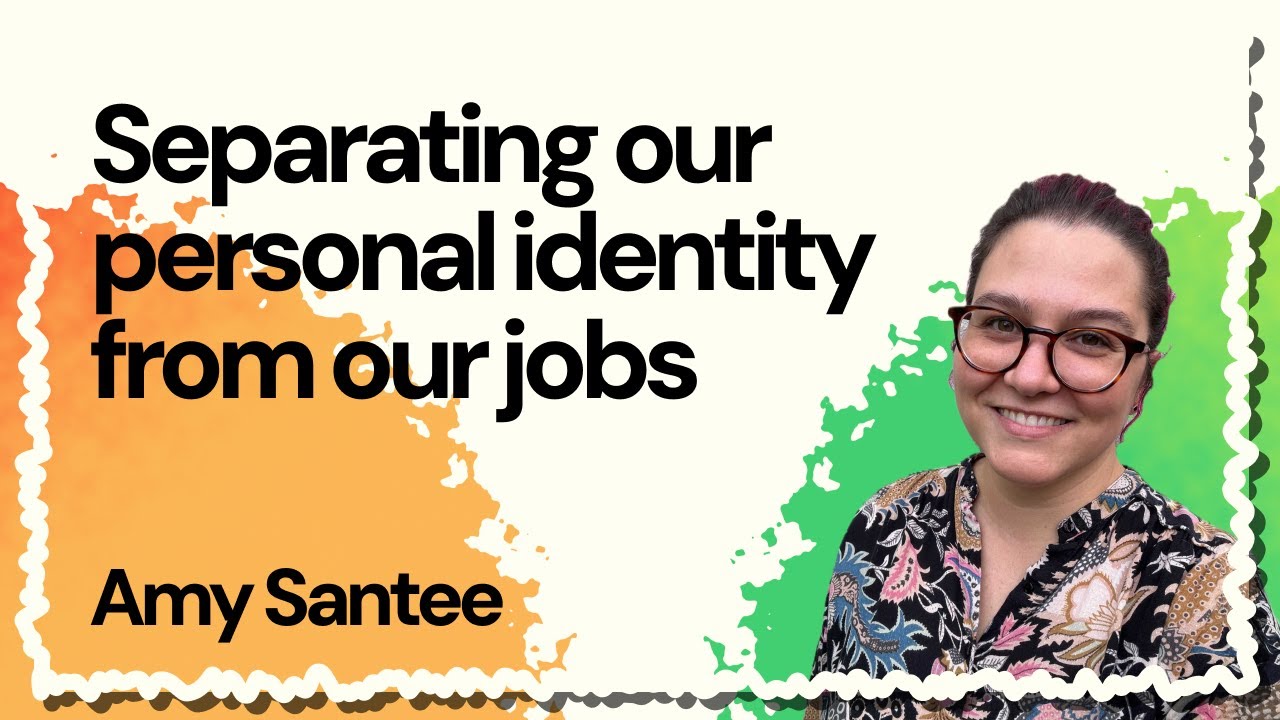
"What happens when your UX career stops fitting the life you want — and you decide to rewrite the story?"
Summary
In this powerful episode, Amy Santee joins me to unpack the realities of building a career in UX — beyond the glossy titles and job descriptions. With a background spanning childhood development, healthcare innovation, and UX strategy at eBay and Civic Software Foundation, Amy has spent over a decade exploring how people, systems, and products connect. Today, as a Design Researcher and Career Strategist, they coach UX professionals through burnout, career change, and the messy realities of the industry. Together, we dive into the emotional and systemic challenges of UX work, the shifting job market, and how to reclaim agency and meaning in your career. We talk about identity, community, and the courage to redefine success on your own terms.
Guest
Amy Santee
Website
LinkedIn
Host
Danny Hearn
Website – www.dannyhearn.me
Podcast – www.deeplyhumandesign.com
(00:00) Amy
A lot of us get hired in UX, especially UX research to, at least we think, to advocate for users, improve the user experience of products, like make things that are actually useful and valuable and respectful to human beings. And I think many of us have those rose colored glasses on and then we get into our jobs and it’s a very different story where we may be blocked from doing
(00:07) Danny
Yeah.
Yeah.
(00:23) Amy
those things and achieving those goals and we have to I don’t know it’s I think there’s a lot of personal turmoil that can come up for some of us
(00:41) Danny
Amy, hello. We meet. So Amy, thank you for coming. Thank you for hearing the call. We haven’t really met. mean, we’ve just been chatting a little bit in our green room for the show, but we haven’t actually met in person. I’ve been tracking you a little bit on LinkedIn and I’ve been really interested in some of the comments you’ve been making about what the hell is going on.
(00:43) Amy
Hello, Danny.
You
(01:11) Danny
And I just thought you’d be like a really interesting voice to bring to the conversation. It’s just, yeah, I’m trying to bring different voices ⁓ that bring different perspectives into this. just for people that won’t know you. ⁓ So I was having a look. It looks like you started out ⁓ in research, ⁓ like a research intern, and then you moved into research, like user research at the State Farm.
And then you did some freelance work.
(01:41) Amy
Yeah, that’s an insurance
company in case you’re not familiar with American corporations. know. Yeah, it actually it did start for farmers that insurance company and now it’s just like a you know, major American insurance corporation. But yeah, right, like right out of grad school, very ⁓ interesting place to start my official research career ⁓ in a very old traditional company kind of some culture shock going on for sure.
(01:45) Danny
⁓ okay. I was thinking like a phone. That sounds cool. ⁓
⁓
Really interesting. Well,
when it says state farm, I thought it meant literally a farm. So yeah, but I can imagine what you’re saying. Yeah. When you come out and you go into like a big machine, a big, you know, corporate entity and it’s like, how do I, how do I navigate?
(02:12) Amy
I wish.
Well, especially
if you come up in a…
discipline like anthropology, which is very critical of things that are, ⁓ you know, business and political structures and systems and things that are harmful to human beings and the environment. Like it is that way. So that’s, you know, generally how, how I see the world anyway. But yeah, going from ⁓ training my master’s program into a big corporation, it was definitely an adjustment that I needed to make.
(02:57) Danny
Yeah, I’d like to pick that out more with you. I just want to, just for people so they know a little bit more about you. So you then freelance an agency, UX research, ⁓ Intel, Jaguar, Land Rover, and then you move to UX, more research roles, and then you, ⁓ researcher at eBay, interesting. I’ll have to talk about that. And then…
(03:18) Amy
Mm-hmm. Yeah.
(03:21) Danny
You did some more research at Civic Research and you moved more into strategy at that point, some quite big brands. And then recently, yeah, well, fairly recently, 2020, you sort of moved into career strategy and coaching for UX people, which was one of the main things that I thought you would have such an interesting perspective on because you’re close to the front line. But let’s just wheel it back to that point that you were just saying.
you know, because I partly think about people that might be listening to this who are at the start of their career. And you were just saying how, you know, what a strange feeling it was to kind of go into this big machine when you’ve got all this training, you’ve done this like really like method sort of quite methodology driven, I imagine, and then you go into some corporate space, and then you have to like translate it into that language. Can you tell me about that?
(04:19) Amy
Yeah, you know, I, when I was working at State Farm, ⁓ I entered onto the consumer research team and then eventually it kind of blended with the user research team. So then I was further exposed to that type of work, which then I carried forward into many other jobs. ⁓ I had a coworker, I had several coworkers who were like, why, what are, what is anthropology and what are you doing here? ⁓ And I
have actually used that question ⁓ as ⁓ part of my publishing, writing, conference work since then, because it’s a recurring theme of asking, what are we even doing in these companies? ⁓ Whether that’s, what are we trying to do here? ⁓
What are we doing as researchers? What are we doing as anthropologists? And yeah, especially over the past 10 years, 10 plus years, a lot of things have stayed the same and a lot of things have changed. But I did have a coworker who drew me a little business card once and it had, it said like Amy Santee, anthropologist and ethnographer. And it had a dinosaur drawn on it because a lot of people also conflate anthropology with one of the sub-disciplines
of anthropology, is archaeology, but archaeology is also not dinosaurs, that’s paleontology. So, so yeah, we have had to do a lot of explaining, ⁓ kind of like coming into these these cultures, but also learning and adjusting and adapting to figure out what we are doing there.
(05:44) Danny
I know.
I, that’s interesting because like I, something really chimed for me when you saying like, what are we actually doing here? I think if I’m really honest, I feel that generally speaking, I have turned down some gigs that I thought, just no, I’m not going to work for that sector or all that thing. But I think generally, maybe this is the case for all designers, you kind of like…
I sort of shut down the outside world and the greater kind of impacts and I kind of just get into my team, my immediate stakeholders, we’re working on the sprint, I’ve got to make this part of the journey function and I’m sort of like slightly, like I’m not going macro and I’m just staying like right in the product or the thing and I kind of like, it’s almost like I can’t hold it all and so I just sort of zero in on the thing that I’m building and
and getting very granular in detail, which is what we’re trying to do. But I hear that what you’re saying, I think is kind of like, hey, like, wake up. What are you actually doing to the world? Is that kind of where you’re going with that?
(07:06) Amy
mean, yeah, what am I doing in my day to day? Like, why am I even in this job? ⁓ A lot of us get hired in UX, especially UX research to, at least we think, to advocate for users, improve the user experience of products, like make things that are actually useful and valuable and respectful to human beings. And I think many of us have those rose colored glasses on and then we get into our jobs and it’s a very different story where we may be blocked from doing
(07:19) Danny
Yeah.
Yeah.
(07:36) Amy
those things and achieving those goals and we have to I don’t know it’s I think there’s a lot of personal turmoil that can come up for some of us I really like what you said I wish I always say I wish I could give myself that advice Mike you know Amy from eBay Amy at State Farm Amy from several years ago where I did care about too much and tried to ⁓ Solve too many challenges internally or with the products that I was working on
And I wish I had a better sense of narrowing my scope. Just like, try to work on these things. Have a good time with your team. Don’t ⁓ put, or don’t even waste energy and effort on things that you won’t be able to do anything about. More along the lines of organizational culture challenges. ⁓ The experience of employees, that sort of thing, yeah.
(08:28) Danny
Yeah. really?
Yeah,
I struggle. So I came to this conclusion in my work that the only way I can do a good job is if I can create the right conditions to do a good job. That was something that I felt quite strongly about and I was like, I can’t design this thing if we’re working without research. I can’t design this thing if everything’s subjective and I’ve got…
like the wrong tools or everybody’s buried in meetings. And I’ve often like, I’ve been thinking about this, like, I think I think you get like consultants, there’s consultants like McKinsey and stuff, and they get like an invitation to change the place to sort of nobody move, everybody drop your mouses, we’re going to go off for three, four days for an offsite, we’re going to we’re going to change how we’re working. And, and I feel like
The alternative to that is sort of like the Trojan Horse Change Agent, which is where like you go in just as a researcher, but then you start like tinkering with the culture, tinkering with the ways of working. And I can’t help myself. I don’t know about you, I can’t help it.
(09:46) Amy
can’t either.
can’t, well, you know, like fundamentally as a human and the way I see the world, I can’t help it, but.
in hindsight, reflecting on these experiences and even in this conversation right now, I actually do think ⁓ we have to acknowledge the constraints of our conditions, as you said, right? ⁓ It is hard for us to change our working conditions ⁓ from many angles. ⁓ Can we get the tools we need? Can we do research for this or that design decision? And I think it’s a question of I would like to do it this way, ideally, versus here’s what’s available to me.
(10:14) Danny
Yeah.
(10:26) Amy
Here’s what’s, yeah, exactly what’s politically or culturally ⁓ available or possible within the organization ⁓ to the point of like starting to like bug other people and disrupt their agendas, right?
(10:26) Danny
Stay problematic.
When you talk about your learning and sense of how it’s better to go, has that been hard one? Have you had failures in order to understand that and to calibrate your approach? Like, did you try it too hard and then it didn’t work or you took too much on? how did you come to the understanding?
(11:07) Amy
I have a pattern, a history of getting really jaded really quickly in my new jobs. Sometimes it takes six months, sometimes it takes three months. And it sounds ridiculous and funny, but I think it’s a matter of that perspective of allowing myself to become jaded in a way, but also I care about and see things and want things to be different.
(11:15) Danny
Yeah.
That’s it.
(11:37) Amy
naturally so that I feel more easily affected by, again, sort of organizational culture practices, ⁓ calling out maybe unethical or deceptive design practices and then being told, you’re ⁓ disrupting the ⁓ team and making them feel bad about their work and all of that stuff. And it’s like, so I think I could
(11:59) Danny
Yeah, yeah.
Yeah, yeah.
(12:07) Amy
go back and point out many examples of things that were not my responsibility to fix or that I didn’t have the energy. so getting jaded also for me ⁓ is the precursor to getting burned out or those things start to happen concurrently where you get burned out. ⁓ Just trying to do your project work on tight timelines, but also like, hey, there’s things that could be better about what we’re shipping and how we do our work and all of that stuff. So yeah, I have time.
tons
of examples, but I think about this for myself in hindsight, but it’s something that comes a lot, comes up a lot with my clients who are ⁓ trying to figure out similar situations and like reframing and going like, what is really worth my time and energy in my short life? ⁓ And it’s like, what do I want to really spend that energy on and what can I do? ⁓ And are there other places outside of my job where it makes more sense to put energy into making change?
(12:58) Danny
Yeah.
You know, when you say that, it’s like, I have this feeling sometimes, and it’s hard to say this without, like, I don’t want to sound arrogant with this, when, if you’ve ever had moments in your role where you feel like you’re doing a flash of something special, like you have articulated something really well and you figured out a problem and the stakeholders love it and you’ve achieved something in that system that you’re in, like, part of me feels,
like really, you know, proud and probably a bit of ego. then part of there is a part of me that thinks like, like, I really putting that that that skill to good use? You know, like, yeah, like I’ve just applied this this energy, this life force, this energy, this thought, creativity, this like, handling the pressure, and what I’ve achieved is like,
(13:50) Amy
like design skills, research skills, or…
Mm-hmm.
(14:03) Danny
getting a stakeholder to buy into a new way of running a checkout, you know? And it’s like, I climbed a mountain and yet, like, in the product design world, I achieved a lot. But when you look outside that world, like, I’ve just helped influence conversion for a stakeholder.
(14:22) Amy
Right, we’re not born into this world as
little babies thinking like, my dream job is to help make the ⁓ insurance purchase process easier for people. We don’t wake up and that is not our goals. But we have to pay our bills. And so I think the more we can use our…
(14:40) Danny
Yeah.
(14:44) Amy
⁓ skills and brains to solve those problems and have our job and pay our bills. But I think what’s important is like seeing the job as a job and not at trying to separate out our personal identities and our sense of self accomplishment, right? Like for you, it’s a big accomplishment to do this podcast and ⁓ you know, all of the like technical setup and logistics involved learning that and having these great conversations and this
(14:58) Danny
⁓ yeah.
in.
(15:14) Amy
This has nothing to do with your job.
(15:17) Danny
No, no, well, yeah, no it doesn’t. mean…
(15:19) Amy
mean,
ish, but no, it’s for you, it’s for the community.
(15:24) Danny
Yeah, yeah, yeah, that’s that was why I was doing it. But, you know, sometimes I find the things that have the biggest impact aren’t the things that were hardest to do. I’ve had really good successes that just came from like an email or something. And then I’ve had other things that were like blood, sweat and tears and like barely moved the needle.
(15:33) Amy
Mm-hmm.
Totally,
totally, yeah. And ⁓ there’s a lot of emotional labor and an invisible labor that goes into our day-to-day trying to just do our projects and get done the things that we need to get done. ⁓ There’s a lot there. And for UXers, it’s not just the technical skills and working on design and research and content. It’s like all of these other ⁓ things, relationships and projects
process and logistics and things like that that are big mountains to, yes, to climb up.
(16:23) Danny
Which when you think about that, it’s no wonder that you get your identity entwined, you know, and something that I noticed that, you you’ve done a lot of commentary on, it’s like, the market is dire. And it’s kind of like, if your identity is wrapped up in a space that is uncertain, unpredictable, and rapidly changing, that’s a hard gig you’ve got there, you know?
(16:51) Amy
Yeah.
(16:52) Danny
if you’re a whole sense of self-worth. And I felt it earlier this year when, you know, because I’ve moved out of London and I live in a small town, so I have to do remote work most of the time. And I went, you I was applying for jobs, all these like product design jobs and stuff, nothing, didn’t get a call back, nothing, I’d never had that in my life. And I was just saying to my partner, I was just like, I don’t have to leave UX, you know, like I can’t get work.
(17:14) Amy
Mm-hmm.
(17:21) Danny
you know, and it like there was a sense of like, I was feeling almost like embarrassed from all the people that know me over the years that they would see that I had like left the UX thing and I’d feel like there’s something like, embarrassing about that, you know, like all these things came in, which is like totally like, no one’s thinking that but yet I felt you know, because of that identity, basically.
(17:42) Amy
Yeah.
I have felt it too. I have felt it too. I don’t, I mean, okay, I did just take a UX research contract job. We were talking about that a few minutes ago, but I would say like, that’s very new for me and I haven’t done it in several years. So up until last month, I was no longer practicing UX, but I was still, you know, as a coach for UX practitioners, still very much involved in the field and keeping tabs on it and trying to figure it out ⁓ and move through the chaos.
like
everyone else and not just the chaos of the job market. That’s one thing, but the chaos of the field and how rapidly everything is changing and all the uncertainty. And so yes, working, you know, in the first couple of years of coaching, and I do work with a lot of job seekers, lots of success there. It was very easy for people to get jobs, multiple offers, a bunch of money, be more selective. Like this is the company I want to work at. This is the kind of work that I want to do. To have higher
expectations for their jobs in the work environment and around the end of 2022, as you know, things really started shifting with all the layoffs, ⁓ the shrinking of teams, ⁓ hiring freezes, like lack of budgets, like all kinds of things. And I, you know, now I mostly work with people who are just having a challenge going through the job search process that is nothing like what they were used to. And many people who
And I don’t blame them. It’s very natural in our capitalist society, ⁓ especially for information workers, knowledge workers. ⁓ If I keep trying and I can’t get a job, I can’t get interviews, or I go through the process and I’m still not getting offers, I must be doing something wrong. The longer you are out of a job, the more shameful it can feel for a lot of people. The more people start to question, do I have a place in UX anymore? ⁓
do I make myself competitive? Like what do I do to even get seen by a recruiter or hiring manager? And folks a lot of the time will internalize the stuff and I typically see it with people who do have a very strong identity with their UX work, but also before we get into UX, maybe you have like advanced degrees in a certain discipline and ⁓ those were big accomplishments for you and maybe again you consider yourself to be more of a knowledge or
information worker and this is how you manifest that stuff in your day to day, right? So when that goes away, when it becomes ⁓ less possible or impossible for a significant amount of time, then yeah, that is a huge, it’s kind of like grieving the loss of identity and it’s not just your identity as a UXer, but maybe your socioeconomic identity as well and what your pay helps you to afford in life with your hobbies and how you spend your free time.
(20:38) Danny
Yeah, yeah.
(20:46) Amy
And the last thing I’ll say with that is I have, and I mentioned this, but to bring it back, I have felt that too, because when…
my client bases, UX professionals, when they don’t have any money, then they can’t like buy coaching services. And so for ⁓ a couple of years now, I’ve seen a decline over time of simply because, you know, people are much more risk averse, they may not have a job tomorrow, maybe they haven’t had a job in a while and they want to hold onto their cash. It is that straightforward. And so then I’ve been asking, gosh, what’s my role in
(21:19) Danny
Yeah, yeah.
(21:24) Amy
UX now. ⁓ people and I have to watch out for that inner critic saying, Amy, no one wants your services anymore. Like, you know, you don’t know what you’re doing. And you know, like, ⁓ it’s your this is your fault somehow. And people like all that inner voice inner critic kind of stuff that I have also dealt with and needed to really try to keep in check, but have struggled to keep in check more recently.
(21:25) Danny
Right.
Yay.
You
find that in your voice is so fickle how you can feel that and then you get some work and then suddenly it’s like because my partner will go you still were to go nice all fine now she was but you were like freaking out like yeah, but you know, the gigs fine like it’s gonna be okay and then you know, like I don’t get work for you know a month or something and I’m like freaking out again and I’m just like man This is hard work. This is tiring, you know, and I I feel like you know, you and I were like, you know
(22:05) Amy
you
It is.
(22:22) Danny
we’re not at start of this. like, kind of feel like in some respects that makes it easier because obviously we’ve got a CV and kind of been around the block a bit. But in another way, it makes it harder because as you say, like your identity is so intertwined. Something that I was thinking about with this is like, know, when we, I’m probably a little older than you, like, but even so, like when we started careers, you kind of think like, what do I want to be? And it’s like, oh, I’m a designer. And it’s like, that means
in your head, like, I’m going to be a designer like, probably for the rest of my life, or certainly for the next 20 years or whatever. And like now it’s all kind of upending, not just in our sector, but you know, everywhere. And there was something that you said, which I really caught my eye, you said, a feature, not a bug, how the tech job market is rigged against workers. And you also said nine out of 10 UX practitioners are considered leaving the field, many of us are asking ourselves, what the hell am I doing anymore?
what’s the point of this? Why doesn’t anyone care about UX? mean, particularly a feature, not a bug, how the tech market is rigged against workers. I really love to hear more about that. I mean, you’ve written a very good post about it, but perhaps for people that haven’t read your blog post, you could tell us a bit more.
(23:35) Amy
Yeah.
Yeah, yeah, there’s a I mean, I’ve touched on this in a lot of my writing on my blog and on LinkedIn and then in the podcast episode over on what is wrong with hiring, which is where I was exploring that question with Lauren Friedman. ⁓ I mean, it’s not just that the job market and the economy is rigged against tech workers in this new era of ⁓ precarity and job instability ⁓ and lowering compensation. It’s all it’s any and all workers. That’s just the
(24:11) Danny
Yeah.
(24:11) Amy
system.
That’s the way I see things and that’s the
(24:14) Danny
We’re not that special.
(24:15) Amy
Yeah, we’re not.
actually, yeah, exactly. And I think ⁓ this ⁓ new instability has made us realize in a very challenging and uncomfortable sort of way. And I say us as like a group of workers, tech workers, UXers is like, shit, like, actually, stuff can get taken away just as easily. ⁓ Our wages can go down. ⁓ Our health care can become expensive. ⁓ My economic standing is not as, as
stable as I thought it was over the past 10 years, know, 20 years, right? And we’ve had different booms and busts, but this is not your typical cyclical boom and bust of an economy like the dot com bubble or not that the 2008 global recession was a normal thing either. That was ⁓ the fault of ⁓ essentially people in in finance ⁓ making decisions that other people had to pay the consequences for.
(24:58) Danny
Yeah.
Yeah. Gambling. Yeah.
Yeah, yeah, yeah, yeah, totally.
(25:14) Amy
Yeah, so I see
it kind of more like that where ⁓ the people who control the levers of the economy, the people who control whether or not you and I have a job and therefore income and therefore, at least in the US, good healthcare, Like groceries, know, that stuff is ⁓ mostly not within our control at a structural level. And so when I say that it is rigged, it’s because other people are making decisions
about our livelihoods and the quality of our well-being and our day-to-day and our families and all of that. ⁓ until we have a shift in how we show up in the workplace as workers and look at ways to exercise the fundamental power we have as humans coming together to advocate for ourselves, it’s going to remain that way. And so what I mean by that is organizing and working
workers
unions and ⁓ creating ways for us to push back or demand the things that we want, which is work, you know, work. We want work. ⁓ We want stability. want ⁓ health care that’s not expensive. ⁓ We want fair pay. ⁓ We want to be able to say no to working on products that we consider to be unethical, right? Like we, we should and could have those things.
We just haven’t really done much in that realm at this point.
(26:48) Danny
I think we have a lot of… I kind of think of like the… It feels like a very white collar problem. It’s sort of like… Well, in the sense that I think of how when I started UX, we were being brought in to build websites which would basically make people shop online and not go into shops so that they could save money. But that means that people who work in the shops…
(26:58) Amy
Hmm. What do mean?
(27:16) Danny
might not be having as many jobs or that means that maybe call centers are going to get trimmed back because if the website is better, they’re not calling up. And so there was this kind of, I always had this like kind of weird feeling of like, you know, and I’d be talking to the call centers and stuff and saying, so how do you do that? And how do do that? And it’d be kind of like working out how to make the website more efficient so that they wouldn’t call the call center. But ultimately, like what that’s going to mean is like less people are needed in the call center. And I think there’s something about you said like,
I was just thinking like, uncertainty in the market has come for other sectors, has come for other classes before, but I feel like particularly at the moment, it’s a real middle class, ⁓ you know, like war zone, because they said with AI, you know, the last job to go is going to be a plumber, you know, and people working construction and stuff like that, like they’re not going to be as impacted by this like redundancy.
(28:08) Amy
You
(28:14) Danny
Whereas people who have been insulated from, in a degree of privilege really, have been insulated by taking, especially in designing UX, taking high day rates and stuff like this, and suddenly the day rates start coming down. And suddenly you can see the way that the market’s looking at it and going, well, synthetic users, right? So we could just create an AI bot to do user research. And suddenly you’re in overhead. You’re not.
opportunity anymore and it’s like the kind of the guns have turned on us you know. ⁓
(28:44) Amy
Right.
It’s,
yeah, I think especially if you make, yeah, if you make a relatively good amount of money, and I would say even if you make, look, $100,000 in the US is not what it used to be, right? It still sounds like a lot, it’s six figures, but it’s really kind of the minimum to live a decent life in an expensive day and age. But even if you make 300,000 pounds, if someone is profiting off of your labor, you’re
(28:52) Danny
Does that make sense?
(29:19) Amy
an exploited worker. think that’s the first thing to know and that is what we have in common. What’s that? Yeah, yeah and and like
(29:21) Danny
Yeah. Expandable. Expandable.
(29:30) Amy
you know, you just because you make that much money, it doesn’t mean you’re insulated. But and now we have plenty of proof of that. I think we have to recognize that this is what every worker has in common across any income level. And if we look in history, whether it’s in the US or in England, in the UK and all across the globe, it’s primarily been ⁓ poor people who have fought the hardest for their rights as workers and as humans. Right.
(29:58) Danny
Yeah, yeah.
(29:59) Amy
And so
like there’s plenty of history with that, but a lot of that has been ⁓ lost ⁓ in the past several decades. A lot of the, mean, especially recently ⁓ in the US and of course in the UK, there are some challenges too with politics and economics. But my point being that these rights have been fought for and won, and then some have been taken away. And ⁓ we kind of need to acknowledge like if we want better working conditions,
if we want better lives, we have to individually, there’s very little we can do to change the system. Going back to our chat from 20 minutes ago, right? Collectively, we can do something about this. It’s just becoming riskier. ⁓ It’s a scarier time. It seems, again, risky to try and band together with coworkers when even though it’s illegal to get fired for organizing and unionizing, people still do get fired.
And then again, in the US, you don’t have healthcare. You can’t go to your specialist because it costs too much. If those things are tied into your employment, then yeah, you’re gonna be less inclined to take those risks for the greater good. But that is literally the only solution to these problems.
(31:19) Danny
Yeah, unions. Yeah, that’s interesting. I can remember my first job, second job actually, they were like, Oh, do you want to join the union? You know, I was like 20, 24, 25. I was like, what? You know, like, they’re like, Oh, we’re going to fight for your rights. And I remember thinking like, what right? You know, like, I didn’t really understand. then, you know, I thought it gets to Friday and then like, because it was Eurostar, it’s a French company. And the unions are strong in France. And it was like, it gets to Friday, everyone goes like…
(31:31) Amy
You
(31:49) Danny
I was like where you going? So 35 hour week. Well, you know great that was union one, you know, and I just like benefited from it had no idea, you know, I was like the other foolish, you know, but like I can definitely See how there have been like things that have been one that an hour eroding and there’s no energy to like regenerate that You know, maybe it’s gonna come but yeah, I can see that definitely
Is that your… because you know, we paint quite a bleak picture here and maybe that’s okay. Like I don’t always want to skirt away from the discomfort and you know, I’m hearing you know, certainly you being on the front line, it sounds like you’re speaking to people that presumably are having quite a hard time with this. what… I mean, how high are the emotions of the people you’re talking to? it quite…
you know, what is the temperature like at the moment, would you say?
(32:49) Amy
Yeah, I mean, look, it is it’s bleak.
It really is bleak ⁓ in tech, in UX, ⁓ in society, in our communities. Like there’s a lot of really, these are dark times that we’re living through. ⁓ And it is important to acknowledge that. ⁓ But at the same time, ⁓ there’s been plenty of dark times and bleakness in the history of humans, in the history of the United States, in the history of the UK, Europe, like really anywhere, right? And ⁓ Martin Luther King,
said, and I don’t know the exact quote, but that the moral arc of history is on like an upward trajectory. So even though it feels like, wow, we’re really sliding backwards on human rights, workers rights. Yeah, if you zoom out, it’s like, you know, hard to see in your lifetime, maybe, but like, ultimately, things are ⁓ on a positive trend. And I do believe that is true. It’s just really hard to, yes, zoom out and get that bigger picture view when you’re going through things every day. ⁓
(33:31) Danny
if you zoom out.
(33:52) Amy
But a lot of creativity comes out of constraints. That’s a truism in design, right? Like what are your constraints? How do you work with those? How do you do creative problem solving with whatever it is that you’re working on or trying to build? And I think that we are in a time where we’re going to have to get super creative. We’re gonna have to have better communities, ⁓ closer communities, whether that’s online, within our profession or locally. So I expect to see
see
⁓ positive things come out of that or adjustments to our expectations and how we use our resources, our limited resources in achieving the things that we want to because institutions are largely broken.
(34:39) Danny
Interesting and in terms of like thinking more about you know what people what can people do like you talked certainly about like union and like collective collectivization like working together Are this other things that you can think of that perhaps some of the people that you’ve helped has worked for them I’m just thinking for people who might be looking for answers and stuff like are there solutions or you’re like oh, yeah, you know, this is like there was one thing that you said I think you said something like the weird and the weird
of your career? Did I read that right?
(35:11) Amy
Yeah, like embrace the weird of your career. It’s sort of like a tagline that I’ve had on my website.
(35:16) Danny
Is
that a place, a mind that people can dig in order to find some creative differentiation, a way to talk about themselves, about their uniqueness? Is that where that comes from?
(35:33) Amy
It’s that, it’s looking back and going, who among us these days has had a straightforward linear career? And that’s becoming less and less common. We come from all of these really interesting backgrounds. We have really unique skill sets that we bring to the table. We are creative problem solvers. We want what’s best for the greater good. yes, I think it is looking at, and also looking at reframing and acknowledging that what we
(35:40) Danny
Clear.
(36:03) Amy
thought the way we thought our lives would go 10 years ago.
That’s not what has happened for a lot of people. The way we want things to go ⁓ is, it’s really hard to know. There’s a lot of uncertainty. There’s a lot of factors at play. And so I think, yeah, just looking at it from that alternative lens, you can call it weird, you can call it ⁓ non-traditional, whatever ⁓ you wanna call it, unconventional. ⁓ And I think that’s just my own personal…
vibe and life philosophy is living unconventionally. And so think we’re just going to have to get more unconventional. ⁓ I see people who are, ⁓ yes, thinking of ways to frame their story more effectively or differently when they’re looking for jobs. ⁓ People who are deciding to leave UX and go into maybe something adjacent or something completely different depends on how they feel about the, you know, discipline of UX and the state of things. So
adjusting and yeah, go ahead.
(37:06) Danny
Have you… Have you
got a game plan? Have you got like, what’s your… Have you got a strategy?
(37:12) Amy
My game
plan is ⁓ take it day by day, pay my bills. ⁓
(37:18) Danny
Yeah.
(37:20) Amy
And it has taken me several months going through periods, like some really challenging periods emotionally around this business I built, ⁓ my coaching practice, kind of like just getting crushed with everything that has happened economically. And that is a really hard thing to accept. But yeah, I think part of it’s acceptance of like what the reality is and unteasing and untangling
my self-identity with these structural issues. So I think that’s a really helpful way for people to look at it and be nicer to themselves and ⁓ start to separate themselves from these macro trends and factors that are affecting them.
(38:06) Danny
I’m definitely hearing like a very good and solid like emotional framing of how to kind of handle the complexity and emotions. Is there a practical strategy that you have as well? Like that’s more, I’m going to apply for these types of roles and you know, do that. Do you have that kind of thing in your head or are you still figuring it out?
(38:31) Amy
You know, it’s like I should, need to like coach myself in the way that I coach other people. There’s a process, you know, it’s not like a step one, two, three, four, five, but there are, yeah, there’s a process and practices that you can implement. And I think the big thing is self-insight, self-research, really reflecting on your life, your experiences, your core values, what it is you care about, and setting that foundation and then using that to assess your potential
(38:34) Danny
Yeah.
Yeah.
(39:01) Amy
futures, the paths that you have forward. So it could be job types or companies, whatever it might be. No! No!
(39:06) Danny
We never had to do this. I never did anything like
this. I just applied to jobs. I would just phone a recruiter up and then they would just say, do you want to work here? Do want to work here? And we’d talk about it as if I’d got the job, because it was just so open door. And you go for one or two interviews and you get one and all this. And I think there’s this whole thing of the hustle.
(39:16) Amy
Yeah.
Right, do you have these 10 skills? Yeah.
(39:36) Danny
that it feels like uncomfortable. But yeah, I’ve felt like I’ve had to I’ve got to lean into it now, which is partly why I’m this podcast. There’s a few reasons why I’m doing it. But partly it’s you know, to sort of help help people get to know me, you know, which is part of it. But it’s like you have to do this hustle, you have to think about almost you is not as a sort of employee, but you as a brand, you know, and it’s something that I find a bit uncomfortable.
So I’m trying to find my way of doing it.
(40:05) Amy
Yeah.
done
a lot of like personal growth work, lots of therapy, lots of reflecting and just, you know, wanting to feel good about my life decisions in general for many years now. And I think I bring in a lot of that stuff where it’s like, you can be asking these questions, you know, trying to make big decisions, important decisions, mitigate risk, ⁓ answering big important questions for your life from for anything related to your life, whether it’s ⁓ your your family life or what you’re how you’re using your
energy and free time. could be with your job. It can be like with anything. And so I think these are practices ⁓ and kind of like treating these questions as a research and design project while also not forgetting to pay attention to our intuition and our life experiences and bringing all that together to get some clarity and narrow our scope and hone in on what it is we want to do and explore the options just
enough to make a decision that we feel good about. I think like I draw from a lot of stuff I draw from UX, I draw from anthropology, I draw from ⁓ all kinds of other disciplines ⁓ in how I help people work through these questions. And again, I’m still trying to use these tools and methods myself. And it’s not so easy sometimes, you know, you can’t just be like, I’m going to do these five steps, and then I’ll figure it out. There’s a lot of moving parts. ⁓ We all have different priorities to
Is your priority to pay the bill? Is your priority to do work that is like super fulfilling? And those things can change too.
(41:45) Danny
Something I thought you say is about redefining value beyond productivity and giving ourselves permission to find worth beyond outputs and algorithms and proving value and sort of what a healthy relationship would look like. And I think you said life is damn short and most of that stuff doesn’t really matter. You have innate value as a human beyond your career, what you produce and what you do for others. that?
(42:13) Amy
Yeah.
(42:15) Danny
Does that sound, I think I got that from one of your.
(42:18) Amy
That sounds like something I would say. Luckily there’s other people who feel that way too. yeah, you know, like to pay my bills, I’ve had to take a step back and go like, what can I just do for money? So I’ve taken on some UX consulting projects. I’ve done like odd jobs and side gigs on like stuff that I used to do in college.
(42:20) Danny
Nah.
(42:39) Amy
for $20 an hour, I try to make, well, personal organizing is something I’ve been doing a bit. Yep, helping, I especially love working with older people who have tons of stuff in their houses and want to just kind of downsize. Yeah, yeah, yeah.
(42:41) Danny
Like what?
Good.
So this is you diversifying. This is your strategy. And I was asking you for practical strategy.
Like this is part of it. You’re actually like broadening beyond the field and you’re just applying whatever the needs are.
(43:08) Amy
I’m just, I really
just want to make money right now. ⁓ I’ve, I have done for a couple of decades now, a lot of selling on eBay and I do that, you know, regardless of my employment, but I’ve shifted into going, okay, how can I do a bit more of that? Just like as a side income stream. And you’re right. I am not into hustle culture. I don’t like any of that as it’s broadly discussed in society and online, but there is some, there’s kind of like,
some hustle to that or creative problem solving. And so yeah, to answer your question or your statement, it is part of my strategy. And to go back to your point about identity and work, to make a shift like that where the way I pay my bills is not using my anthropology degree, it’s not user research, it’s not coaching, it’s just like, let me do this thing for 50 bucks an hour, that…
(43:58) Danny
Yeah. Yeah.
(44:05) Amy
is not something I thought I would need to do when I was in grad school. Like I didn’t predict that. Yeah.
(44:09) Danny
I’d find that really hard. Yeah, I’d find that like, I think if I’m, did
volunteer work and that felt fine. But I think if I was being paid for it and then being paid like, you know, what I would see as a lot less than what I would get working UX, like I’d find that deeply uncomfortable.
(44:26) Amy
It is uncomfortable because you don’t know what’s next either. Like how long will I have to continue doing this? But I personally am recognizing that I’m becoming more comfortable with what I’m doing to pay my bills and to just like, yeah, be a person. Like be a good person with the people who are in my life. Like that is something I can continue to focus on.
(44:27) Danny
And yeah.
Has that brought you anything unexpected? Like working for the lower wage but doing maybe more human work in some cases, like helping old people with their sort of things out and stuff? Has that brought anything unexpected, do think?
(45:05) Amy
you
⁓ it’s, one thing I like about it, and it’s kind of entrepreneurial in a way is the variety of the work. I can plug things in when I have time for this or that. I, lot of the ways I spend my time, I’m a bird watcher. ⁓ I’m, again, I sell stuff on eBay and I specialize in certain things like collectibles and vintage. Both of those, bird watching and reselling, ⁓ are, ⁓
really driven by curiosity and learning. Like I’m constantly learning and enjoying ⁓ both of those activities. One is to pay my bills, one is purely for enjoyment ⁓ and being outdoors, right? So it has been nice actually to focus on things ⁓ that are very different than computer work and user experience, but fulfill that same need I have of curiosity and like endless learning about interesting topics.
(46:01) Danny
Yeah, yeah.
Yeah, brilliant. Well, hopefully, hopefully this is, you know, food for thought for people who might be struggling in the sector and maybe feeling uncomfortable about doing something else and you’re doing it, you know, and you’re still keeping your toe, your foot in the scene, but you’re also diversifying and trying some of the things and experiencing different things out of it as well. perhaps that will be helpful for people. you know, and that’s…
(46:32) Amy
Yeah.
It doesn’t mean
you’re bad at your…
discipline anymore doesn’t mean you don’t belong in your field anymore. It doesn’t actually mean the things that society tells us. Yeah, it doesn’t mean like you have no like worth to the economy anymore. So like you might as well just like it doesn’t actually mean that that’s the stories we’re told and the stories we grew up with. ⁓ And the narrative, ⁓ you know, more broadly speaking, but that’s the adjustment that I think can be really helpful to make is like, what do I actually care about?
(46:42) Danny
your worthness.
I think that’s a really good point to end on. I feel like that’s a really good underscore of the conversation. I really appreciate that. It’s going to give me something to think about in this uncertain time because nobody’s safe and we’re all figuring this out and think taking that philosophy that you’re talking about could be really helpful.
(47:35) Amy
Yeah, yeah, it’s ⁓ been I have felt a lot of shame around this and I have this like.
desire or fantasy like every day I want to like share this with people. I want other people to know that ⁓ there, you know, lots of folks are going through the same thing, but it is hard when you feel so much shame about ⁓ such a drastic change that is really hard to resolve. ⁓ But you got to like work through that stuff and see things from these other angles and start to separate yourself out. And I, I do think I am in
kind of a new phase now with that myself where I’m adjusting and doesn’t mean I like what’s happening, but I’m kind of accepting it and just adapting to things as much as I can. Yeah.
(48:22) Danny
You think of the grief wheel, you know, like
you’re in acceptance.
(48:29) Amy
Yeah, yeah, exactly. then, you know, grief isn’t linear. So sometimes you go back to the anger part and sometimes you go back to the disbelief. So yeah.
(48:35) Danny
Yeah, yeah, yeah,
yeah, brilliant. Amy, thank you so much. Thanks for sharing conversation with me and thanks for being really honest and open about how you’re navigating this and yeah, thank you. I hope it’s helpful.
(48:41) Amy
Thank you so much, Danny.
Yeah, appreciate
you inviting me onto your show.
(48:55) Danny
Yeah, thank you. Thank you very much. Thanks, Amy.